
Want to know how we help others in your industry?
What is Texture Analysis?
The physical properties of foods and other materials are measured based on force vs distance measurements.
Uses & Applications
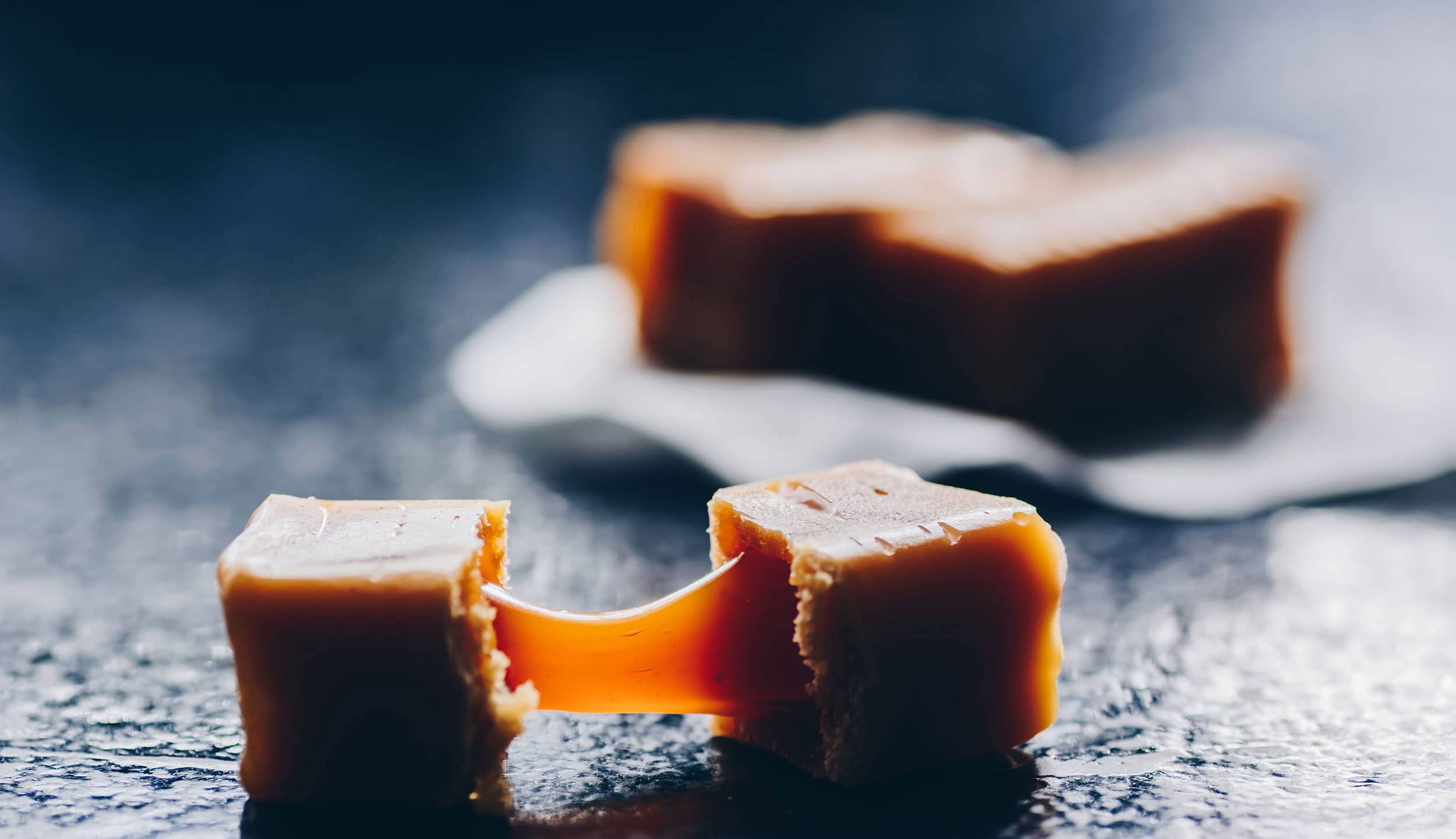
Texture analysis testing is vital in various industries, including food and cosmetics, to evaluate product quality. It measures attributes like hardness, stickiness, and gel strength, providing insights into how a product feels, behaves, or reacts under specific conditions.
This information aids in product development, quality control, and consumer satisfaction, as texture often influences consumer perceptions and preferences
WHAT WE DO
The Texture Analysis Testing Lab Process
also applied to various other products. This simple technique mimics real-world interactions such as:
Crushing and compression
Cutting, biting and slicing
Piercing and penetration
Pull-off and adhesion
Tensile, stretch and extension
Dragging and lubrication
Extrusion and back extrusion
Bending and snapping
Folding/Bending
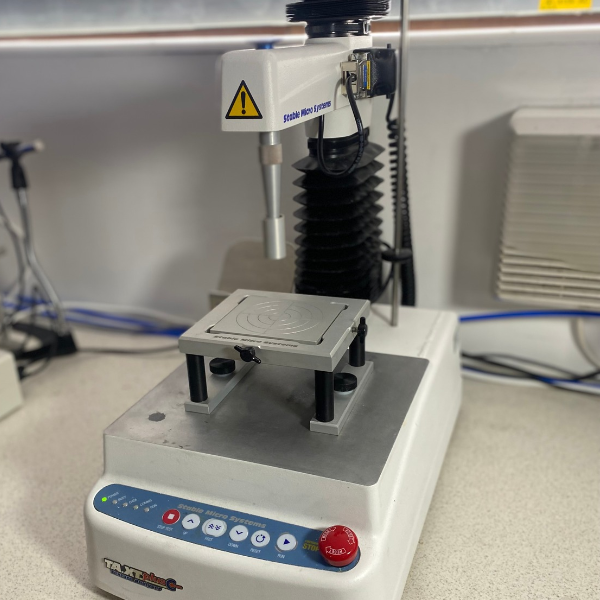
An appropriate probe contacts the sample and a load cell measures force. Plots of force vs distance or force vs time are obtained from which a range of metrics can be quantified.
Additionally, the sound output of fracturing foods can be captured and processed to quantify crispiness and crunchiness.
Industries
Stable Micro Systems Texture Analyser
How it works
How Does Texture Profile Analysis Work?
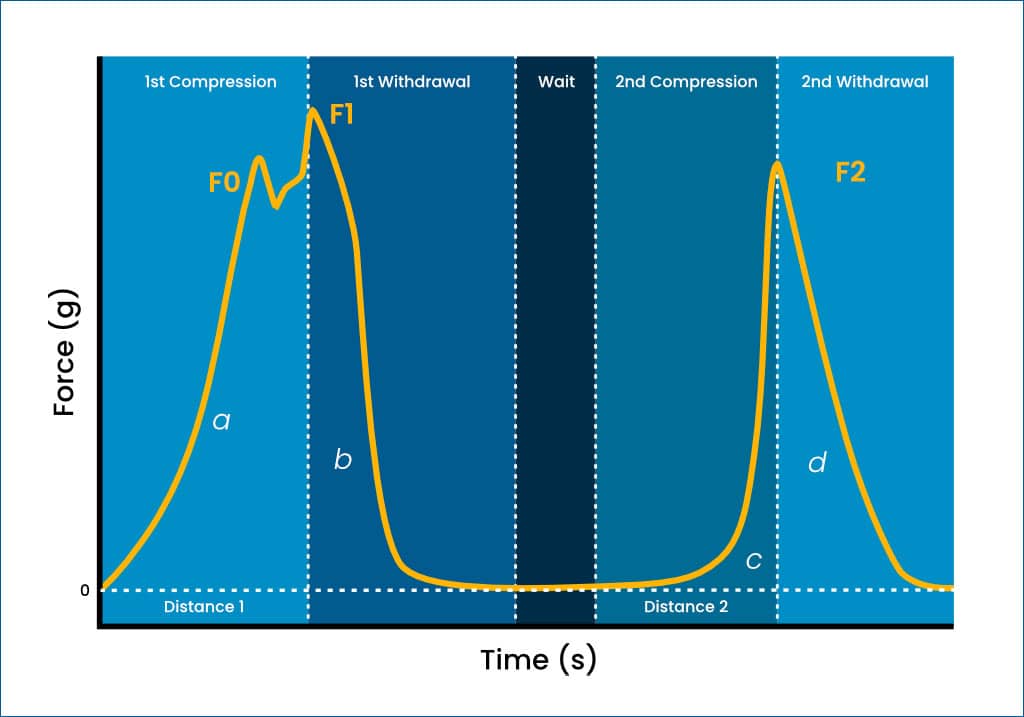
Texture Profile Analysis, or TPA, is an established technique that mimics a “two-bite” process on foods. The resulting force/distance plots are interrogated to obtain a range of properties relevant to the oral processing of a food product.
1st Compression:
The probe descends onto the sample; once contact is detected, measurement begins, and the probe descends at a defined speed for a set distance or a set time.
1st Withdrawal:
Once the target distance or time is reached, the probe ascends away from the sample at a typically faster speed for a set distance or a set time.
Wait:
The sample is allowed to recover for a defined time
Repeat:
Repeat compression and withdrawal
A typical TPA output plot is shown below:
What the terms mean
A Summary of Texture Profile Analysis Metrics
Understanding the different terms and measurements encountered in texture profile analysis can be complicated. Here, you can find a guide to each term and its meaning.
What does it mean?
The force at which any initial fracture occurs during the first “bite”/compression
How is it calculated?
Force F0
What does it mean?
The peak force reached during the first “bite.”
How is it calculated?
Force F1
What does it mean?
The ability for a product to remain intact after the first compression
How is it calculated?
(Area c+d)/(Area a+b)
What does it mean?
The ability of a sample to return to its original shape and integrity
How is it calculated?
Distance 2/Distance 1
What does it mean?
The product of peak bite strength and cohesion of a product
How is it calculated?
Hardness x Cohesiveness
What does it mean?
The product of hardness, cohesion and springiness
How is it calculated?
Hardness x cohesiveness x springiness
What does it mean?
The ability of a product to maintain integrity after the peak of the first bite/compression
How is it calculated?
Area b/Area a
Discover more about our texture analysis measurement lab by reading a case study
Upon receipt of your samples, we will:

Measure
Perform measurements of the appropriate properties (softness, tackiness, deformability, gel strength, etc.) of relevance to your products.

Present
Present and explain the results and discuss insights gained with reference to your needs.

Support
Provide you with the support necessary to maximise the potential of the analyses and confidently communicate and discuss the findings.
Other techniques & capabilities
Find out more about our other techniques and capabilities by following the links below.