
Want to know how we help others in your industry?
How we help
Common problems we solve for household products and cleaners:
Optimise Spray Performance
Rheometers measure viscosity across shear rates that are unattainable through basic viscometers. Dynamic surface tension measurements combine with this to help optimise droplet size and surface coverage.
Compare Detergent Foams
Dynamic foam analysis quantifies foamability, foam stability and bubble size distribution. Interfacial measurements can then be used to explain why one formulation’s foam collapses faster than another’s.
Optimise Pour & Cling
Rheology provides insights into how a product will behave when pumped or poured, including capturing the stress that holds a product against a vertical surface. Contact angle can also be measured as a function of tilt.
Screen Sustainable Surfactants
Bubble pressure tensiometry measures dynamic surface tension from 5 ms. Surfactant adsorption kinetics can then be used to benchmark conventional surfactants against bio-surfactants.
Predict Formulation Stability
A specialised rheological toolkit captures behaviours such as zero-shear viscosity, yield stress, and time-dependent viscoelastic behaviour to rapidly predict stability.
Test Hard Water Effects
Dynamic foam analysis compares foam height, stability and bubble count distribution in hard and soft water. The same detergent can behave very differently between the two.
Working With You
Your Partner in Rheology and Physical Testing
We provide expert, economical, and swift sample analyses of detergents, surface cleaners, fabric conditioners and powders for our clients. We deliver results with friendly and accessible support to ensure our clients can fully exploit the value of the insights generated and confidently communicate those insights to other stakeholders.
Common Questions Answered
Challenges and Solutions
Challenge
“How can I compare the foaming behaviour of my new detergent formulation candidates?”
Solution
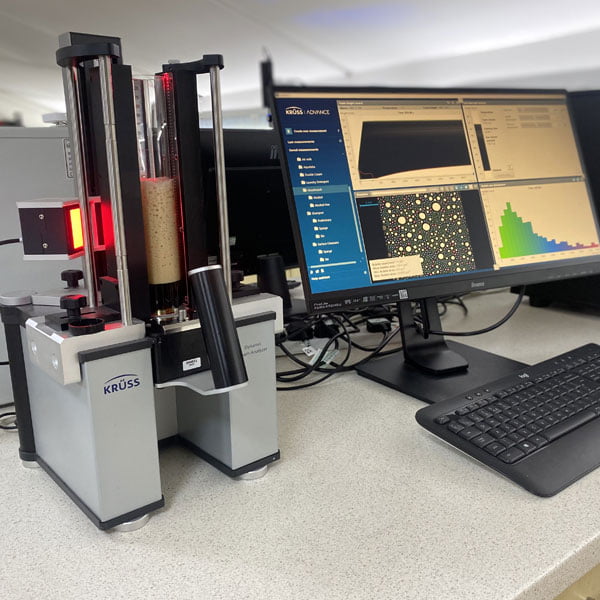
Dynamic foam analysis enables the easy comparison of detergents for foamability and foam stability. The method creates a foam using either a sparging or stirring approach, then measures the height of the liquid and foam fractions, providing metrics for foamability and foam stability. Foam structure and bubble size distribution are also tracked to identify coalescence processes.
The method enables the rapid screening of detergents under a variety of conditions, such as in hard or soft water, in the presence of other dissolved or dispersed components or at various temperatures.

Challenge
“I want a rapid prediction for atomisation performances for our sprays.”
Solution
Satisfactory atomisation of sprayed products can be limited by poor rheology. Excessive viscosity under high shear conditions hinders ejection from the nozzle and prevents sufficient turbulent flow, which inhibits atomisation. Furthermore, the presence of extensional viscosity and viscoelasticity can significantly impact spray formation. Normal stress rheology measurements can provide an indication of the presence of such behaviours in a formulation.
Challenge
“How can I compare anti-caking agents for my powders?”
Solution
To compare anti-caking agents for your powders, we would employ a dynamic powder flowability test. Dynamic powder flow tests measure the energy needed to drive a rotating blade through a column of sample – the more energy required, the less flowable the powder.
Conducting multiple tests on powder samples that have undergone humidity and temperature cycling enables us to quantify the resulting degree of caking and the ease of subsequent cake break-up.
Learn more about our rheology testing lab for household surface cleaners, detergents and more.
Crucial Analysis
Why Does Rheology Matter for Household Cleaning Products?
Properly understanding rheology, interfacial, foaming, and powder flow properties can equip household product formulators with powerful insights. These can help you develop market-leading products, setting you apart from competitors.
The impact of these properties on surface cleaners, detergents, fabric softeners, and stain removers is extensive. They influence the handling, storage, application and cleaning performance significantly. A knowledge of these critical materials’ properties will help an astute formulator to gain a competitive advantage.
About us
Get in touch
Dynamic Foam Analyser
Learn more about how we’ve helped improve performance of household products and cleaners by reading the case studies and articles below.
Household Cleaners Case Studies And Articles














The Methods We Use
Relevant Techniques
You can learn more about our capabilities regarding detergents, fabric conditioners and household surface cleaners by following the links below.