
Want to know how we help others in your industry?
How we help
Common problems we solve for adhesives and sealants:
Improve Tack, Grab & Peel
Axial testing measures tack and peel directly. Oscillatory rheology relates both to the adhesive’s internal structure, separating cohesive strength from adhesive strength.
Predict Gel Time and Cure Profiles
Oscillatory time sweeps track structure building as the adhesive cures. Temperature ramps identify the gel point and how cure responds to processing conditions.
Predict Dispensing Force
Rotational rheology profiles viscosity across the shear rates of gunning and extrusion. Structural breakdown under increasing stress shows how readily the product starts to flow.
Stop Post-Application Sag
Oscillatory stress sweeps reveal the structure holding your product in place at rest. Thixotropy testing shows how quickly that structure rebuilds after application.
Validate Against Supplier Specifications
Rotational rheology reproduces the viscosity figures on a supplier’s certificate of analysis. Oscillatory testing exposes the behaviours a single flow curve leaves out.
Optimise Substrate Wetting
Contact angle measurement shows how readily your adhesive spreads on a substrate. Surface energy testing reveals whether pre-treatment is needed for full contact.
Working With You
Rheology and Viscosity Lab for Adhesives and Sealants
We offer in-depth and efficient rheology and viscosity testing for a wide range of adhesives and sealants, from pressure-sensitive and hot melt adhesives to grab adhesives and multi-component systems. Our team delivers results with supportive and easily understood guidance, so you can put the insights gained to work.
Common Questions Answered
Challenges and Solutions
Challenge
“How can I predict the ease of application and the subsequent slump resistance of my sealants?”
Solution
We conduct extensive rheological tests to ascertain the likelihood of a sealant’s slump resistance. These tests, like controlled rate viscosity profiles, oscillatory stress sweeps, and thixotropy studies, provide insights into the flowability, rigidity, structural breakdown, and recovery speed of the sealant. This, in turn, indicates its gunnability and sagging potential.

Challenge
“My adhesives are forming a skin on curing. How do I measure the dynamics of this process?”
Solution
We can measure the dynamics of skin formation in our adhesives using dynamic surface rheology. The technique provides insights into the strength and rigidity of the films formed. This is achieved by monitoring the complex modulus, storage and loss moduli, and the cross-over point.
Challenge
“Our adhesive is difficult to pump and dispense, but changing the formulation causes it to separate in storage.”
Solution
Most adhesives are non-Newtonian, so their viscosity changes with the shear they experience. Shear rate sweeps capture behaviour from the zero shear viscosity plateau, which governs sedimentation and phase separation at rest, through to the high shear conditions of pumping, mixing, coating and spraying.
Measuring across process-relevant temperatures helps you strike the right balance between easy handling and long-term stability.
Challenge
“I need to understand how our pressure-sensitive adhesive will perform across different temperatures and timescales.”
Solution
Oscillatory temperature ramps identify the glass transition and the final modulus crossover, which mark the lower and upper limits of a pressure-sensitive adhesive’s application temperature. Frequency sweeps, extended using time-temperature superposition, relate high-frequency behaviour to peel strength and low-frequency behaviour to shear resistance.
Creep tests quantify cold flow directly, and can be used to predict how an adhesive will behave over much longer periods than the test itself.
Discover how our rheology and physical characterisation lab can support your adhesives and sealants development.
What We Do
Physical Insights for Adhesives and Sealants
Physical properties play a crucial role in the processing and performance of adhesives and sealants. Viscosity, viscoelasticity, yield stress, thixotropy and cure behaviour all influence how a product pumps and dispenses, how well it grabs and resists sag once applied, how quickly it sets and how it performs across its service temperature range. Reliable and relevant measurements of these attributes, and effective communication of the insights gained, are prerequisites for successful product and process development. We provide expert physical testing services and support for formulators and process engineers, equipping them with the insights they need to bring winning products to the marketplace.
About us
Get in touch
High-performance rotational rheometers
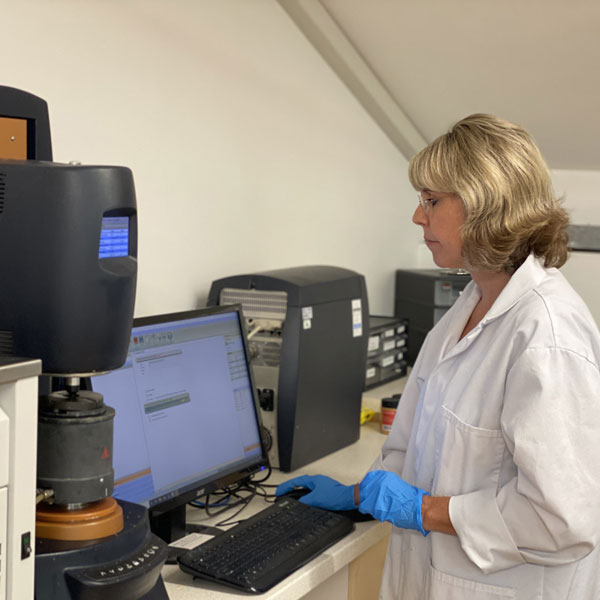
Follow the link for more information on how our rheology and viscosity lab supports adhesives and sealants.
Adhesives & Sealants Resources

















The Methods We Use
Relevant Techniques
You can learn more about each technique and how it can benefit your product by following the links below: