
Want to know how we help others in your industry?
What is Interfacial Testing?
Measurement of the physical strength, rigidity, and elasticity of the two-dimensional interface between liquids, solids and gases.
On This Page:
Uses & Applications
Understanding the physical properties of the interfaces that exist both within a product and in product/environment interactions equips formulators with the knowledge to accelerate their research, innovate confidently, and make data-driven decisions swiftly.
Comprehension of the properties of interfaces through in-depth interfacial testing is paramount for improving the performance of pharmaceuticals, foods, coatings, adhesives, and other manufactured materials.
How We Help You
Why Measure Surface and Interfacial Properties?
Surface and interfacial tension, contact angle, wetting, surface energy measurements, and interfacial rheology all offer essential insights when:
Predicting coating, wetting and dewetting behaviours
Benchmarking the impact of salt and pH on surfactant performance
Demonstrating equivalence of pharmaceutical formulations
Predicting emulsion stability
Identifying foam-stabilising properties
Understanding spraying and atomisation processes
Discover how our interfacial testing lab can benefit your industry
Industries
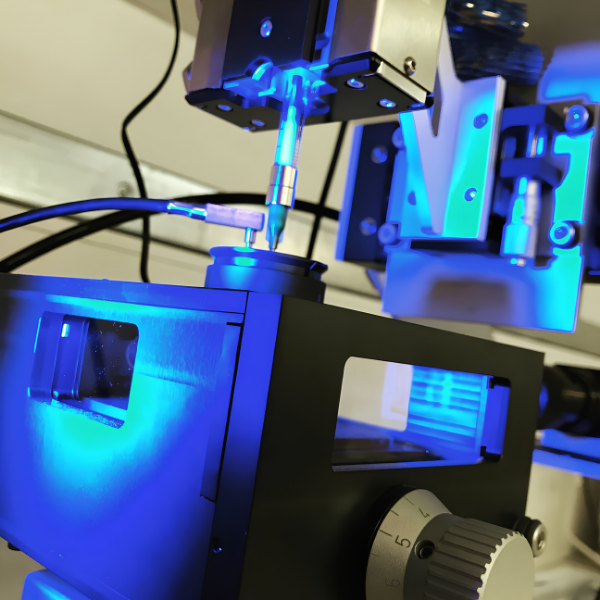
Drop Shape Analyser
Do you want expert surface and interfacial tension testing?
THE METHODS WE USE
Surface and Interfacial Tension Measurements
Surface tension is a measure of the “pull” of the cohesive “skin” at an air/liquid interface, and interfacial tension is the equivalent at a liquid/liquid interface. Depending on the timescales relevant to your application, we can capture dynamic surface tension from milliseconds through to equilibrium surface tension values. We use two key methods for capturing surface tension, with temperature control available between 5 to 110°C.
Bubble pressure tensiometry
Pendant drop analysis
5 ms
1 s
10 s
Equilibrium
Pendant Drop Analysis
For most samples
Surface and interfacial tension measured over time, from about one second through to equilibrium. Suited to most applications, and our route to liquid/liquid interfacial tension for emulsions and surfactant comparisons.
Timescale: ~1 s to equilibrium
Interfaces: Air/liquid and liquid/liquid

Bubble Pressure Tensiometry
For dynamic processes
For interfaces created on very short timescales, the maximum bubble pressure method extends surface tension measurement down to surface ages of 5 ms, capturing the surfactant adsorption kinetics behind spraying, foaming, inkjet printing and high-speed coating.
Timescale: 5 ms to 10 s
Interfaces: Air/liquid
In-depth Testing
Contact Angle and Wettability Measurements
The contact angle is the internal angle at which a deposited or “sessile” drop contacts a surface. Contact angle measurements enable the investigation of the wetting of surfaces with a range of liquids. Contact angles range from 0 degrees for complete wetting to 180 degrees for complete non-wetting.
Measuring hydrophobic and hydrophilic surfaces
In the case of wetting with water, a contact angle greater than 90 degrees indicates a hydrophobic surface, and one less than 90 degrees indicates a hydrophilic surface.
Dynamic Contact Angle Measurements
Dynamic contact angle measurement is the quantification of advancing and receding contact angles. Advancing contact angle is associated with wetting fresh, previously un-wetted surfaces. The receding contact angle is that angle associated with the de-wetting of a surface as the liquid front recedes.
The difference between advancing and receding contact angle is known as contact angle hysteresis and can inform about the uniformity of surface treatment, its roughness and cleanliness.
Dynamic contact angle measurement is conducted in two ways:
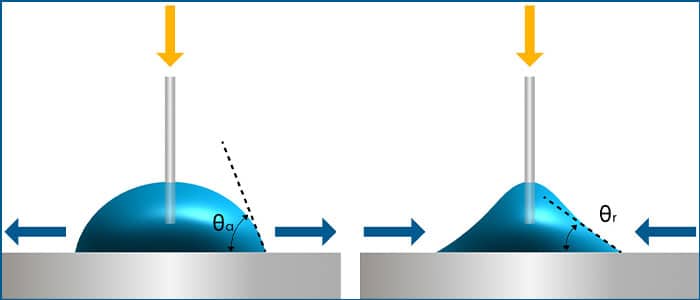
Through altering the volume of a sessile drop by dosing liquid to form a maximum advancing angle (figure A) and removing liquid to create a minimum receding angle (figure B).
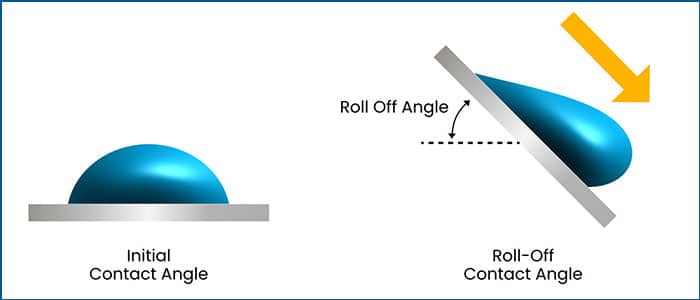
Using a tilting table, which measures the angles at the front and rear of a drop at the point of incipient movement. This method can also measure the roll-off angle, a simple measure of the draining ability of a surface.
Dynamic Wetting Measurement
Dynamic wetting can be recorded using high-speed imaging to capture the contact angle at rapid intervals following droplet deposition. This can inform on the rapid adsorption of surface-active entities or on situations where significant interaction, either chemical or physical, with a surface may occur.
Applications of dynamic wetting measurements include:
Determining surface functionality.
Development of self-cleansing films, fabrics and glass surfaces.
Measuring the spreading rate of various liquids on a surface.
Find out more about how our contact angle testing methods can benefit your industry
CLOSE RAPID ANALYSIS
Surface Free Energy Measurements
Surface free energy (SFE) measures a solid surface’s available energy for promoting liquid wetting. A low SFE surface, such as PTFE, resists wetting and a high SFE surface, such as glass, promotes wetting.
Surface free energy is calculated from contact angle measurements of the sample surface using liquids of known surface tension components.
Surface free energy measurements can also be split into two contributions: a polar component and a disperse component. The polar contribution results from permanent electron asymmetry in local molecules, and the disperse component results from more ephemeral charge fluctuations.
ANOTHER DIMENSION OF TESTING
Interfacial Rheology Measurement
Interfacial rheology measurements add another dimension to interfacial characterisations. Interfacial rheology enables the characterisation of viscoelastic properties of an interface, such as modulus and stress relaxation. These properties arise from the time-dependent interchange of surface-active entities between the bulk solution and the interface. Interfacial rheology helps to keep cosmetic emulsions stable and vegan milk foams frothy.
Dilatational and shear interfacial rheology testing
Two modes of deformation are available for interfacial rheology measurements:
Dilatational interfacial rheology is performed by oscillating a pendant drop to cycle the creation and contraction of the interface. Modulus values are calculated from surface tension and area information and observation of the phase shift between the two.
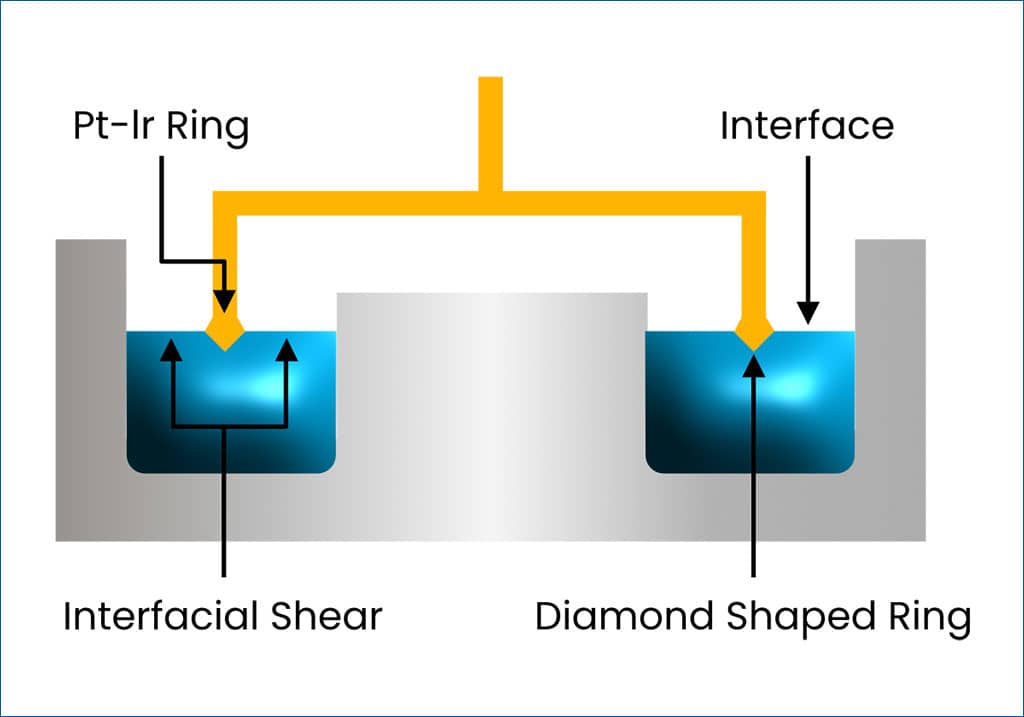
Shear interfacial rheology is performed by positioning a du Noüy ring at the surface or interface and applying continuous or oscillatory shear. In contrast to dilatational measurements, the interfacial area remains constant in shear interfacial rheology.
Upon receipt of your samples, we will:

Measure
Perform measurements of the appropriate properties (surface tension, surface energy, interfacial rheology, etc.) relevant to your products.

Present
Present and explain the results and discuss the insights gained with reference to your needs.

Support
Provide the support necessary to exploit the analysis and confidently communicate and discuss the findings.
Other techniques & capabilities
Find out more about our other techniques and capabilities by following the links below.