
Want to know how we help others in your industry?
What is Particle Analysis?
Analysing particles allows quantification of metrics such as zeta potential and particle size distribution, which contribute to stability, performance and processability across a wide range of formulated products.
On This Page:
Uses & Applications
Whether characterising nanoparticles, emulsion droplets, protein aggregates, or larger suspended solids, understanding particle size distribution and surface charge informs formulation decisions, helps to predict stability, and supports quality control and regulatory submissions.
When combined with rheological and interfacial measurements, particle characterisation helps to provide a uniquely complete picture for formulations.
What we do
Particle Analysis at the Centre for Industrial Rheology can support:
Particle size distribution characterisation across the nano to macro scale
Stability profiling through zeta potential and polydispersity index measurements
Early detection of aggregation and formulation instability
Regulatory and pharmacopoeial submissions
Do you need particle analysis for your samples?
The Methods We Use
Dynamic Light Scattering
Particle Size Distribution and Polydispersity Index
Dynamic light scattering (DLS) is a versatile, non-destructive analytical technique used to determine particle size distribution, polydispersity index, and hydrodynamic diameter. With a measurable particle size range of 1 nm to 15 µm, it is well suited to characterising nanoparticles, proteins, emulsions, polymers, and colloidal dispersions.
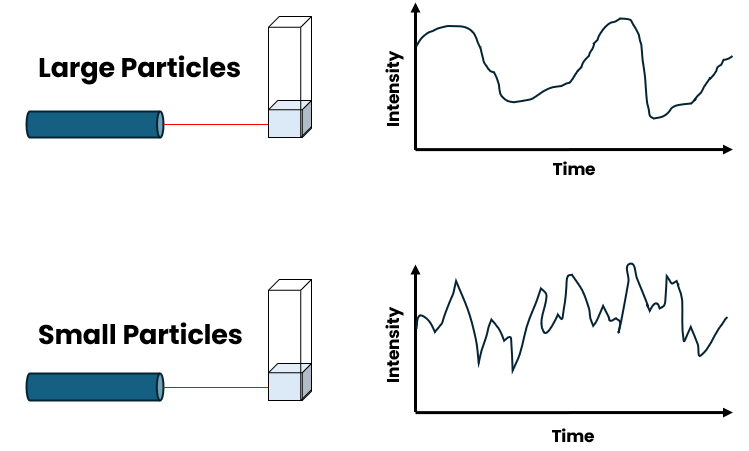 When a laser is directed through a sample, particles in suspension scatter the light in all directions. Because particles undergo continuous, random Brownian motion, the intensity of scattered light fluctuates over time. DLS captures these fluctuations and uses them to calculate a diffusion coefficient, which is then converted into a hydrodynamic diameter via the Stokes-Einstein equation. Smaller particles diffuse rapidly and produce fast fluctuations, while larger particles diffuse more slowly and produce slower fluctuations, allowing size to be inferred directly from the dynamics of the scattered light.
Key outputs from DLS measurements include:
✓
Particle Size Distribution
✓
Polydispersity Index (PDI)
✓
Z-Average
✓
Particle Concentration
In addition to particle size distribution, we can assess the homogeneity of a sample through the polydispersity index. In practical terms, the polydispersity index tells us whether the particles in a solution are roughly uniform in size, or whether they span a wide range. The polydispersity index is scaled from 0 to 1. Values closer to 0 indicate a monodisperse sample in which particles are highly uniform in size. Values approaching 1 suggest a broad or polydisperse distribution, signalling that the sample may be non-uniform and could contain large aggregates, contaminants, or multiple distinct particle populations. A shift toward a higher PDI is often a warning sign of formulation instability.
The Methods We Use
Multi-Angle Dynamic Light Scattering
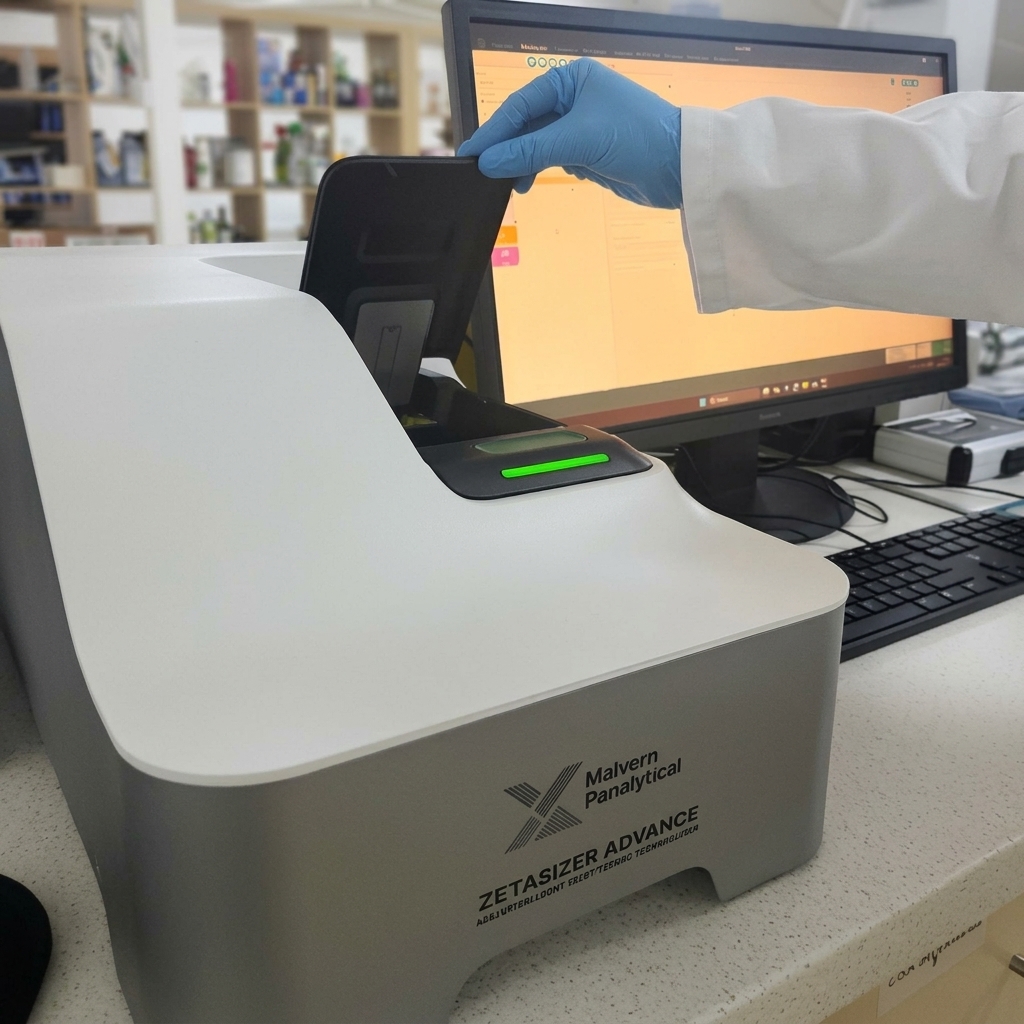
Our Malvern Zetasizer Advance Ultra Red is equipped to perform multi-angle dynamic light scattering, collecting data simultaneously at three angles, backscatter, side-scatter, and forward scatter. By combining these datasets, MADLS reduces measurement noise and improves size resolution from a 3:1 ratio down to approximately 2:1.
In practice, this means that samples containing multiple particle populations of similar size are far more likely to be resolved as distinct peaks, rather than appearing as a single broad distribution that could be misinterpreted.
The data above illustrates the difference in output between standard DLS and MADLS measurements. It can be seen that MADLS successfully resolves multiple populations that were not well characterised through standard DLS. Specifically, highlighting a population at 1.2 nm that was not distinctly seen previously.
The Methods We Use
Zeta Potential
Electrostatic Stability Assessment
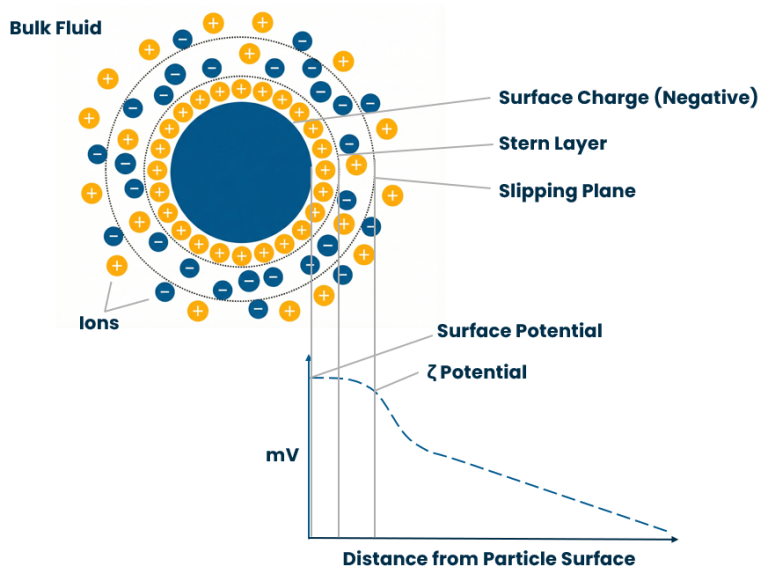 Zeta potential measurements extend the capabilities of our Zetasizer platform by monitoring electrophoretic mobility. By applying an electric field and measuring how rapidly particles migrate within it, we can determine the electrostatic charge at the slipping plane, which is the boundary between the Stern layer and the surrounding diffuse charge cloud. This is the zeta potential.
Zeta potential is a commonly used metric for assessing electrostatic stability in dispersions. The closer the zeta potential to 0 mV, the more likely a dispersion is to be electrostatically unstable, with particles prone to aggregation or flocculation. Conversely, larger positive or negative values indicate stronger electrostatic repulsion between particles, acting to stabilise the dispersion.
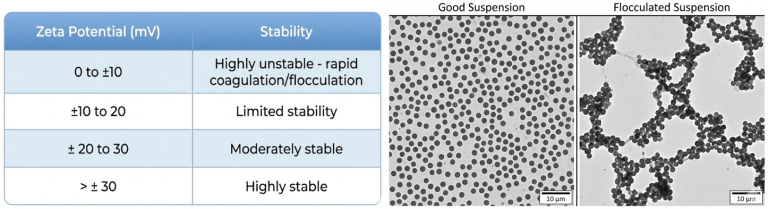
Where electrostatic instability is identified, stabilisation strategies may include:
Increasing the continuous phase zero-shear viscosity
Imparting structure and yield stress, or incorporating sterically adsorbing polymers
Engineering a more robust interfacial layer around dispersed droplets or particles
When combined with rheological or interfacial measurements, zeta potential characterisation helps to provide a comprehensive understanding of sample stability.
For Larger Particles
Laser Diffraction
Laser diffraction particle analysis
For materials containing particles beyond the size range accessible to dynamic light scattering, we can extend our particle sizing capabilities through laser diffraction. While DLS is optimised for sub-micron and nanoscale materials, laser diffraction covers a broader size range suited to larger particles, granules, and suspensions of coarser materials.
This ensures that across the DLS range of 1 nm to 15 µm and into the larger particle regime addressed by laser diffraction, we can provide particle size data relevant to virtually any dispersed material system. Whether your samples are nanoscale protein aggregates or coarser particulate suspensions, we can select the most appropriate technique and deliver data that is useful for your application.
Upon receipt of your samples, we will:

Measure
Perform appropriate particle analysis techniques relevant to your products.

Present
Present and explain the results, discussing the insights gained with reference to your specific needs.

Support
Provide the support necessary to exploit the analyses and confidently communicate and discuss the findings.
Other techniques & capabilities
Find out more about our other techniques and capabilities by following the links below.