
Want to know how we help others in your industry?
What is Rheo-Microscopy Testing?
Simultaneous imaging and rheological characterisation to understand microstructural changes.
Uses & Applications
Used in industries like food, cosmetics, and pharmaceuticals, rheo-microscopy provides insights into particle distribution, phase separation, or structural evolution, aiding in product formulation and quality control.
WHAT WE DO
Why Perform Rheo-Microscopy?
Rheo-Microscopy delivers insights into microstructural processes and their physical effects, creating a unique tool that can inform on:
Melting and crystallisation
Dissolution and precipitation
Shear-induced structure breakdown
Thixotropy
Agglomeration, aggregation and dispersion
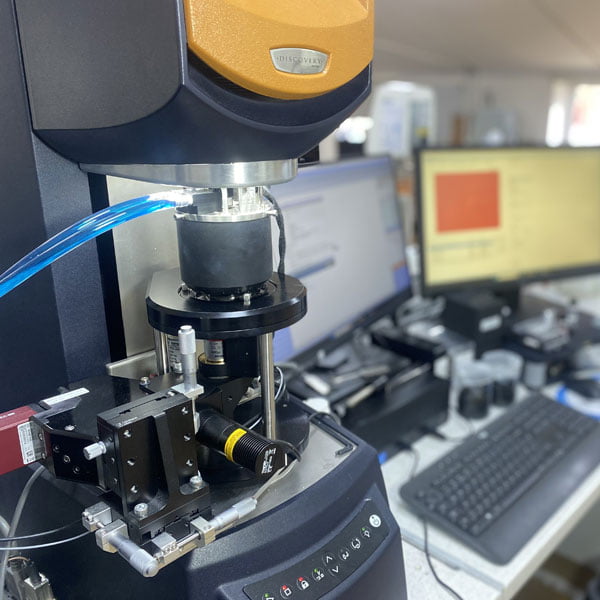
Rheo-microscopy combines rheological measurements with microscopic imaging. Our rheo-optics testing lab comprises a sophisticated rheometer with a microscope mounted beneath a transparent base plate. This allows the user to visualise how samples behave under shear whilst concurrently collecting rheological data.
Learn how our rheo-microscopy testing can benefit your industry
Industries
Rheo-microscopy attachment for Rheometer
Are you looking for a rheo-optics testing lab for your business?
Why is rheo-microscopy sample testing vital?
A material’s microstructure imparts rheological properties such as non-Newtonian shear thinning, thixotropy or the presence of a yield stress. Rheometry probes these behaviours by studying responses to the application of shear. Rheo-microscopy measurements can help us visually observe the microstructure changes contributing to these properties.
How does rheo-microscopy testing work?
By their nature, materials under flow can be complicated to visualise, especially at high shear rates. This is due to features of interest, like droplets and particles passing swiftly over the objective. To combat this, we create a stagnation plane in the shear field by rotating the transparent base plate in the opposite direction to the upper geometry.
Whilst under shear, the sample at the stagnation plane is stationary relative to the camera. This allows features of interest to be kept in the field of view throughout the test.
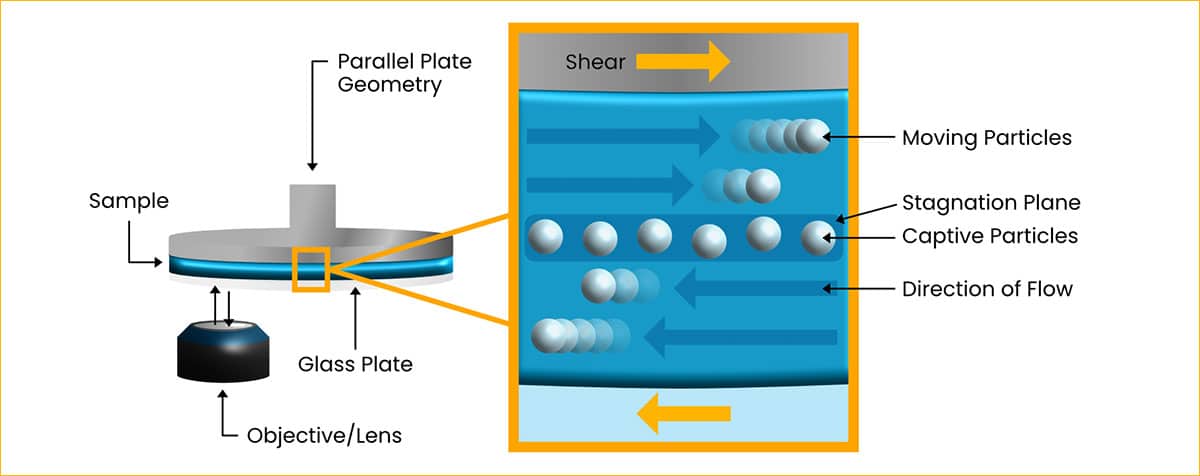
Above: A diagram illustrating how the counter-rotating glass plate produces a stagnation plate, holding particles in space above the objective.
What is the impact of temperature?
Temperature also has a significant influence on the flow characteristics of most substances. Melting and cooling profiles can be captured with a rheometer by observing changes in modulus (rigidity) or viscosity. With the addition of microscopy at the point of measurement, the cause of these changes can be observed.
As a sample is heated or cooled, crystals can be seen forming, growing or melting directly under the microscope. Rheo-microscopy can therefore be applied to characterising temperature effects in materials like lipids, fats, greases and waxes. Polarised light, fluorescence and stains can also be used where extra contrast helps, for example with gels or cheese.
What to learn more about our rheo-microscopy testing services? Why not read a case study?
Rheo-microscopy Resources
STATE OF THE ART FACILITIES
What Equipment Do We Use?
Our lab benefits from industry-leading equipment, allowing us to ensure rapid and accurate results. We use a TA Instruments HR20 research rheometer fitted with the following attachments:
Modular Microscope Accessory (MMA)
Upper Peltier Plate to control temperatures between 5 °C and 100 °C
50/50 beam splitter for brightfield applications
Dichroic beam splitter for fluorescence microscopy
Variable polariser for selective illumination
X-Y-Z micrometre position system allowing flexible field of view adjustments
Piezo scanning system for precise depth profiling
Find out how our services can support your business by viewing our Industries page
Upon receipt of your samples, we will:

Measure
Capture the properties (crystallisation, dissolution, erosion, etc.) relevant to your needs.

Present
Present and explain the results, and discuss the insights gained with reference to your needs.

Support
Provide the support necessary to exploit the analyses and confidently communicate and discuss the findings.
Other techniques & capabilities
Find out more about our other techniques and capabilities by following the links below.