
Want to know how we help others in your industry?
What is Powder Rheology?
The combination of cohesion, internal friction, and other flow properties of bulk solids.
On This Page:
Uses & Applications
Powder flow testing is pivotal in industries like pharmaceuticals, foods, and cosmetics. It measures properties such as flowability, cohesion, and bulk density of powder substances.
These insights are critical for product formulation, manufacturing processes, quality control, and packaging design. Ensuring optimal powder flow can lead to increased production efficiency, product consistency, and consumer satisfaction.
How We Help You
Why Measure Powder Flow?
Powder flow testing and powder rheology measurements provide a range of insights for predicting the behaviour of bulk solids, flagging process issues in advance and reducing downtime. Powder flow measurements can help predict:
Discharge difficulties
Arching and ratholing in hoppers and silos
Dusting, fluidisation and aeration
Caking and consolidation
Wetting and dispersion
Segregation
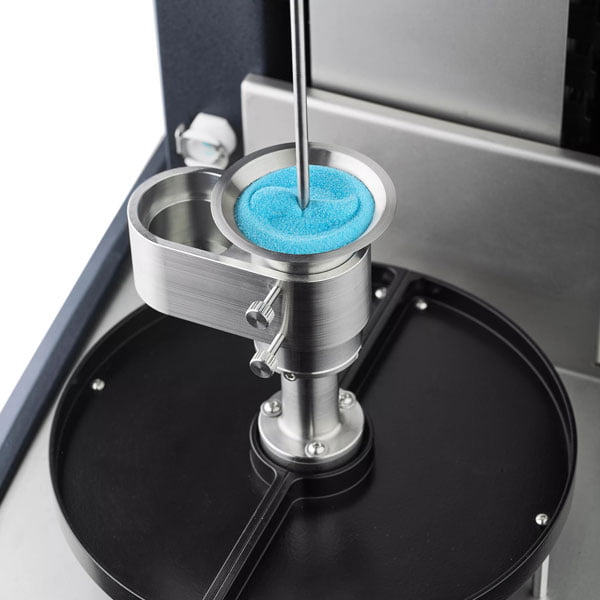
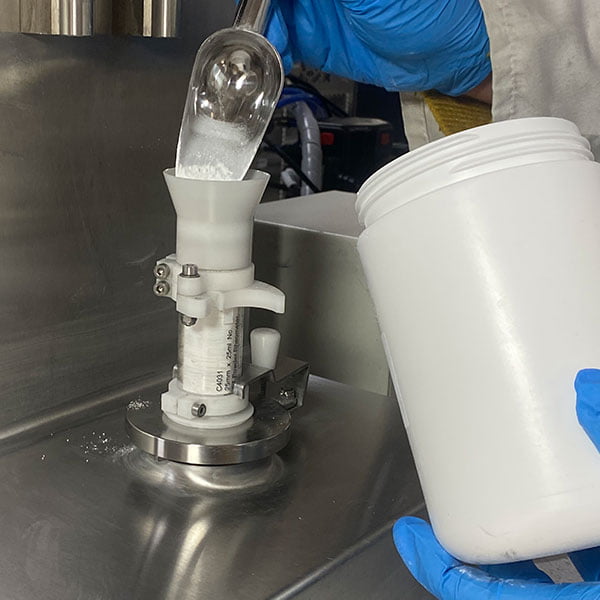
Powder attachment for powder flow measurements
Traditional methods such as angle of repose, Carr’s Index and bulk/tapped density lack the detail and sensitivity to describe how the powder will behave across many scenarios.
Our powder flow laboratory tests comprise:
Shear cell and wall friction tests
Dynamic powder rheology testing
Consolidation and compaction assessments
Aeration and permeability
Are you looking for a powder flowability test for your products or processes?
THE METHODS WE USE
Shear Cell Powder Testing
Shear cell measurements are the established method for capturing powder flow properties for hopper design calculations. Minimum arching dimensions and hopper angles for mass flow can be obtained for the storage of food ingredients, minerals and other industrial bulk powders.
How does it work?
Shear cell powder flow measurements entail measuring the failure strength of a powder mass under a range of applied load stresses. By doing this, we obtain the yield locus, which lets us quantify key flowability metrics:
Cohesion: The intrinsic strength of a powder mass resulting from particle interactions.
Angle of internal friction: A measure of the ability of a powder mass to build strength with increasing consolidation stress.
Powder Flow Function
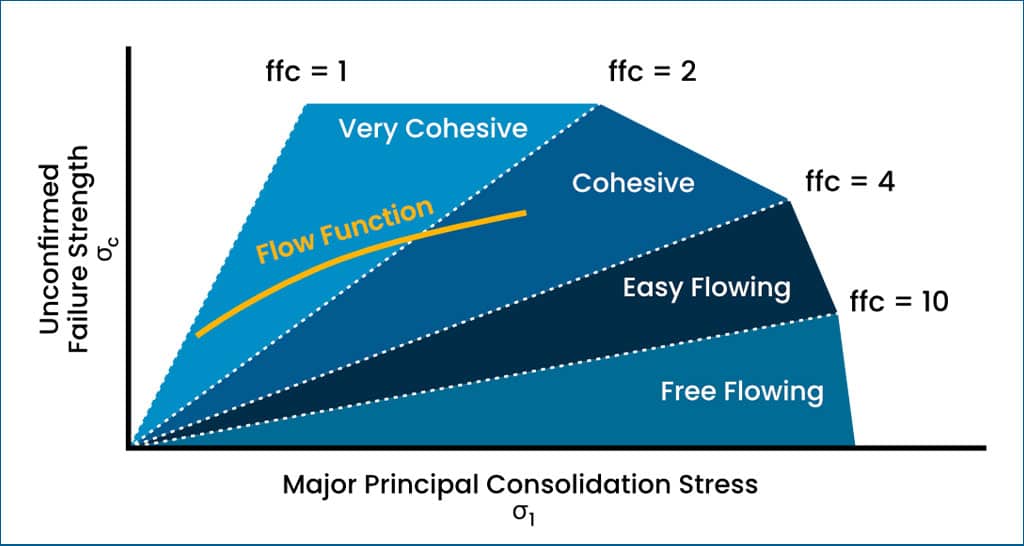
The flow function gives a simple, commonly used comparison of flowability for powders. The unconfined yield strength at an applied major principal stress is obtained by constructing Mohr’s circles onto the yield locus.
The ratio of the applied stress to yield strength gives us the flow function coefficient (FFC), a simple metric that can be compared to Jenike’s ranges, as seen below.
Wall Friction
Powders display varying degrees of friction against certain surfaces resulting from surface roughness, particle size and distribution, and attractive forces. Wall and internal friction influence the likelihood of a powder mass demonstrating an undesirable funnel flow or, in the extreme, rat-hole formation.
Wall friction measurements are performed against a range of relevant surfaces of various materials and roughness. The results are usually presented as the wall friction angle as a function of normal stress.
How it works
Dynamic Measurements
Dynamic powder flow measurements quantify various metrics especially relevant to powders in low-stress and mobile circumstances. These include pneumatic conveying, die and cavity filling, aerosolisation, and fluidisation.
Basic Flow Energy and Specific Energy
During the testing process, a blade is rotated through a column of the powder sample, and the energy expended (in millijoules) is recorded. Dynamic powder rheology delivers two metrics:
Basic flow energy (BFE) is the energy expended to drive the blade aggressively down through the column.
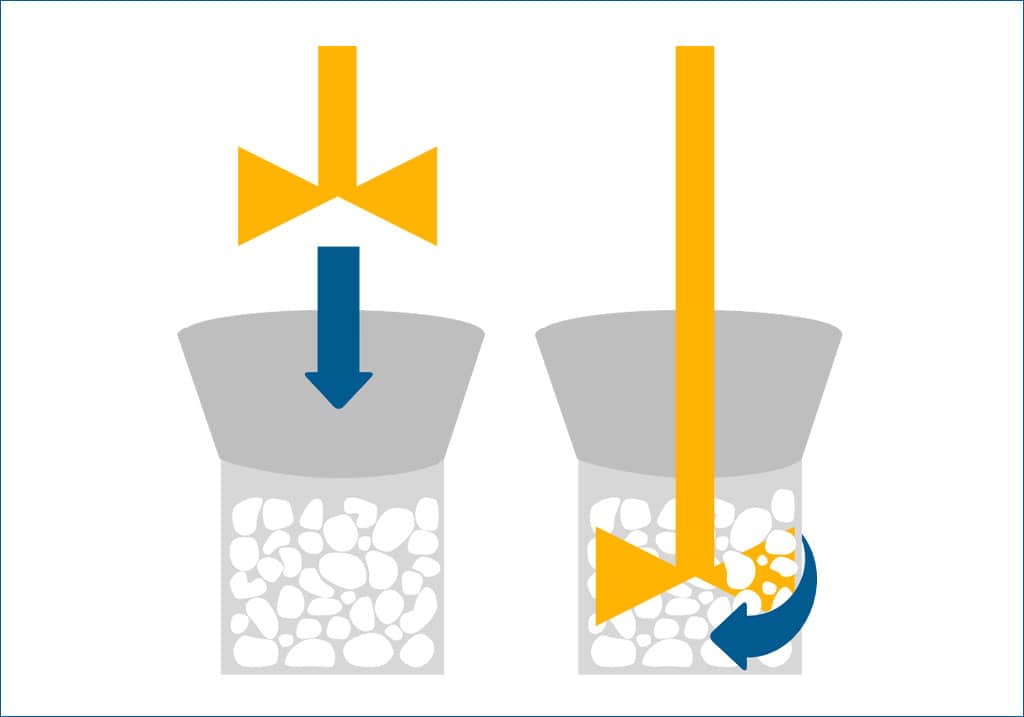
Specific energy is the energy required to lift a rotating blade through the column of powder. The unconfined nature of this test means interparticle attraction and powder mass cohesion likely have a significant impact on the measurement.
Stability Index and Flow Rate Index
Repeating the test several times on the same sample gives the Stability Index (SI), which shows whether a powder changes as it is forced to flow. A value close to 1 indicates a stable powder, while values further from 1 can point to changes such as attrition, agglomeration or segregation.
Repeating the test at different blade speeds gives the Flow Rate Index (FRI), which shows how sensitive a powder is to changes in flow speed. Most powders need more energy to flow slowly than quickly, and the higher the FRI, the more sensitive the powder is. This is particularly relevant for processes where flow rate varies, such as start-up, shutdown or changes in line speed.
Aeration Studies
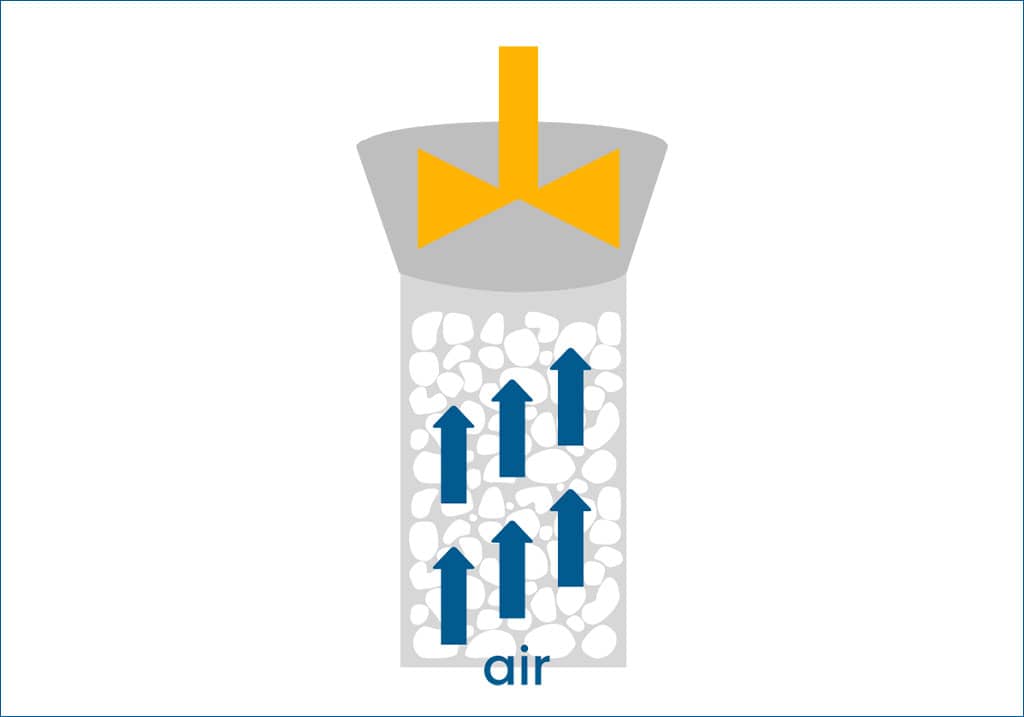
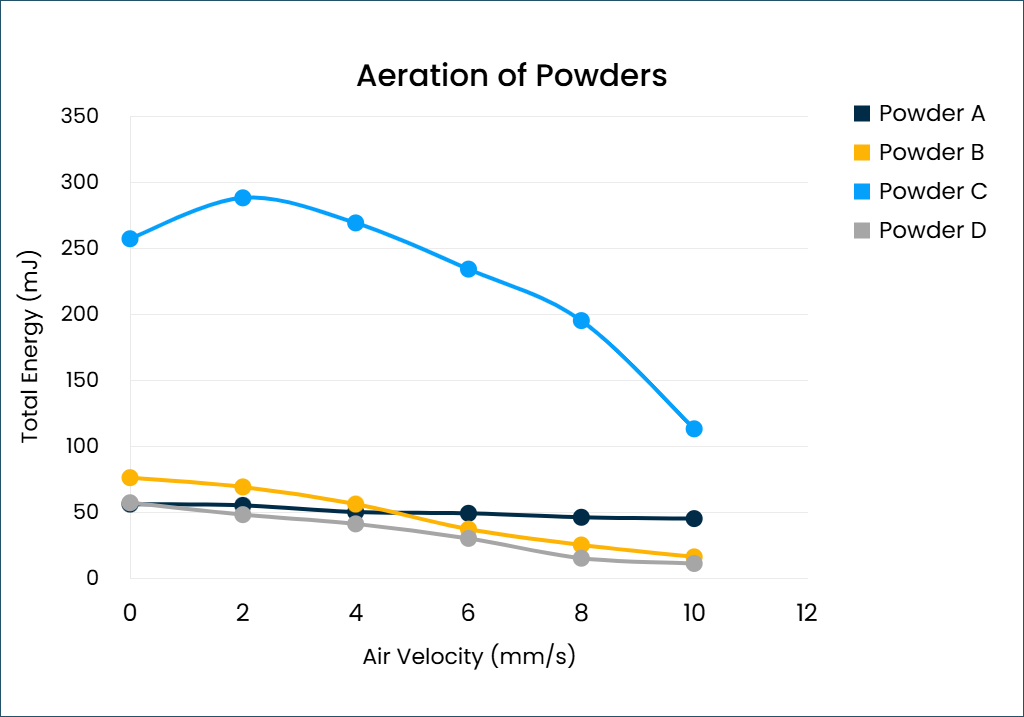
Passing air through a powder column undergoing dynamic testing enables aeration behaviour to be investigated and compared. Flow energy is plotted as a function of aeration velocity with a significant drop in energy with increasing flow, signifying potential ease of fluidisation.
IN-DEPTH ANALYSIS
Permeability
Permeability measurements predict the ability of a powder to retain or release air. Air retention results in fluidisation, whilst easy air release facilitates rapid filling under low stress situations, such as in capsule or tabletting operations.
We perform permeability measurements by measuring the pressure drop of a stream of air across a powder column. During the process, air velocity and applied compressive stress are controlled.
ASSESSING COMPRESSIBILITY
Compressibility and Bulk Density
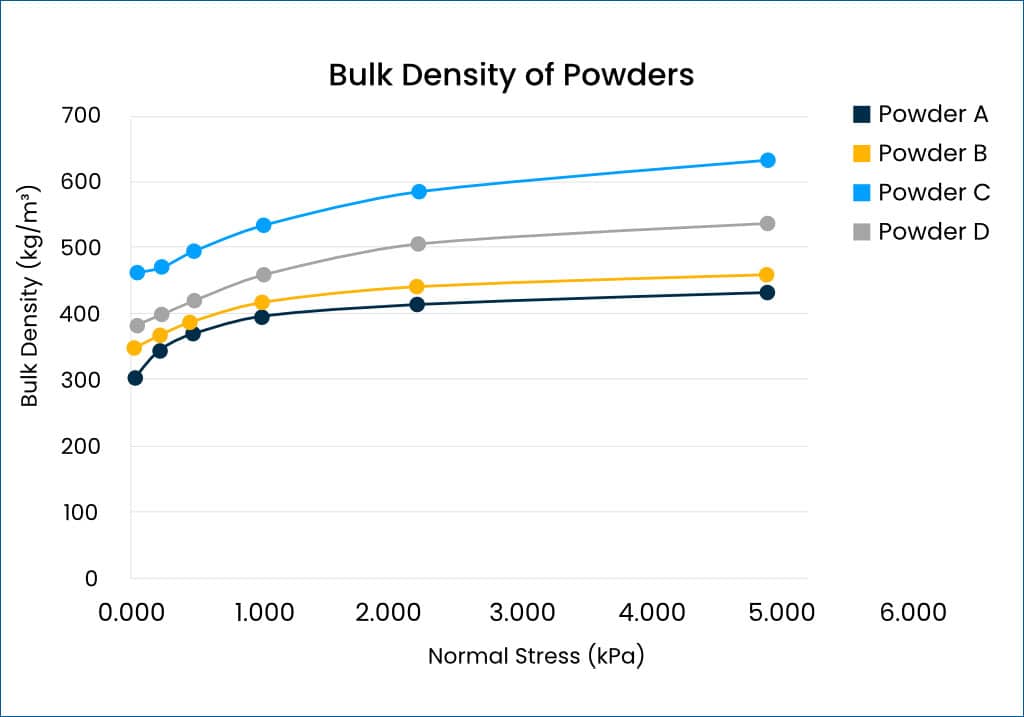
Compressibility is a measure of bulk density under a range of defined loads. Compressibility and bulk density are important factors that contribute to gravity-driven flow processes such as hopper flow and filling.
Caking and Crusting
Powder Caking, Crusting and Agglomeration
On an industrial scale, powder caking has the potential to ruin production runs and bring factories to a halt. At a consumer experience level, powder caking renders supplements, protein powders and cooking ingredients difficult to handle and disperse.
A robust caking study conducted at a specialised powder flow testing lab can provide early indicators of a powder’s propensity to cake.
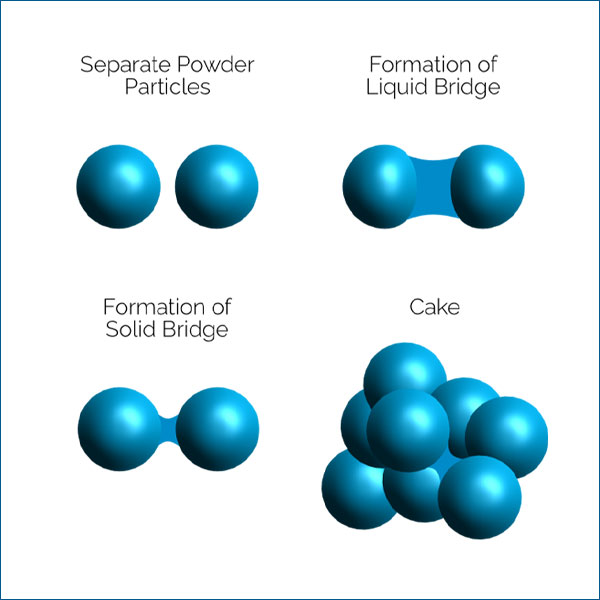
Powders cake when moisture ingress dissolves soluble solid material to form liquid capillary bridges between adjacent particles. Drying of the powder mass subsequently results in the solidification of those bridges to create a hard, connected network of particles.
We recreate this process through temperature and humidity cycling in our climatic chamber. Dynamic measurements of flow energy are performed before and after the conditioning step to ascertain the degree of caking.
Caking Process
Understanding Cake Breakdown
By conducting multiple tests on a caked sample and comparing the results with the un-caked powder, we can give insight into the ease with which a cake is broken down. We can also identify whether a caked powder returns to its original flowability post-breakdown or whether a permanent change has occurred.
Discover more about the industries we support to see how we can help your business.
Upon receipt of your samples, we will:

Measure
Perform appropriate measurements of the properties (cohesion, flow function, flow energy, etc.) of relevance to your products and process.

Present
Present and explain the results and discuss the insights gained with reference to your needs.

Support
Provide the support necessary to exploit the analyses and confidently communicate and discuss the findings.
Other techniques & capabilities
Find out more about our other techniques and capabilities by following the links below.