
Want to know how we help others in your industry?
How we help
Common problems we solve for electronic materials:
Investigate Print Issues
Rheological profiling captures shear thinning behaviour, relevant to how an ink will pass through the mesh in screen printing. Oscillatory profiling can then be used to identify the yield stress a squeegee must overcome to elicit flow.
Stop Paste Slumping
Oscillatory rheological profiling can be used to measure the structure resisting slump once deposited. Thixotropic profiling is also used to show how quickly structure rebuilds, as slow recovery can cause misprints.
Optimise Electrode Slurries
Rheological profiling provides insights into shear-thinning behaviour, yield stress, and zero-shear viscosity across mixing, coating and drying. Rheo-impedance spectroscopy adds a nuanced level of detail on top.
Assess Battery Powders
Dynamic powder flow testing quantifies the cohesion and flowability of battery powders. Conditioning at controlled humidity and temperatures shows how storage and handling alter behaviour before mixing.
Measure Substrate Wetting
Contact angle measurements show how readily an ink or coating spreads on a substrate. Surface free energy testing identifies whether the substrate needs treating first.
Quantify Thermal Performance
Thermal conductivity testing measures how efficiently products such as thermal interface materials move heat away. Measurements across temperature show whether that performance holds at operating conditions.
How We Help
What We Do and How It Supports You
The materials discussed above are notoriously challenging to measure with everyday viscometers. Demanding needs for viscosity measurements across a range of shear conditions, in combination with other factors like thixotropy and viscoelasticity information, make high-performance rheometers a necessity.
Our rheology analysis lab specialises in electronic materials. It provides profiling, benchmarking and competitive comparisons to help you optimise product development, quality assurance and more.
Common Questions Answered
Challenges and Solutions
Challenge
“How do we predict the impact of reformulation on the print quality of our conductive screen inks?”
Solution
The rheological properties of conductive screen-printed inks go beyond simple viscosity measurements that appear on the datasheet. Viscoelastic properties, obtained through oscillatory and normal stress testing, can reveal behaviours not attainable through more traditional approaches.

Challenge
“How can I characterise my battery electrode slurries to optimise my coating process?”
Solution
We measure rheological properties such as viscosity, shear thinning, yield stress, zero-shear viscosity and interfacial rheology to characterise battery electrode slurries. This data helps you optimise mixing, storage, coating and drying, supporting consistent electrode quality and battery performance
Challenge
“How can I predict the wettability of my substrates?”
Solution
Our specialist lab allows us to predict the wettability of substrates by performing contact angle measurements. A lower contact angle indicates higher wettability. Surface energy, surface roughness, and chemical composition are key influencing factors. Our lab is equipped with specialist equipment to provide accuracy and expediency of measurement.
Challenge
“How can I investigate the difference in conformal coating batches causing performance problems?”
Solution
To investigate the differences in conformal coating batches causing performance problems, we carry out surface and rheology measurements. This includes measuring viscosity at various shear conditions, characterising viscoelastic properties, and examining wetting properties and surface tension.
Want to find out more about our physical characterisation of conductive coatings and more?
A Clear Understanding
The Physical Properties of Electronic Materials
An understanding of physical properties like rheology, surface tension, wetting and thermal conductivity is crucial in the electronics industry. Whether you’re a formulator or a process developer using electronic materials, properly grasping these characteristics can enhance productivity and the quality of results.
From printable electronics using conductive and resistive pastes to slurries and inks for batteries and fuel cells, the material insights from our rheology testing services save time, avoid delays and boost performance.
About us
Get in touch
High-performance rotational rheometers
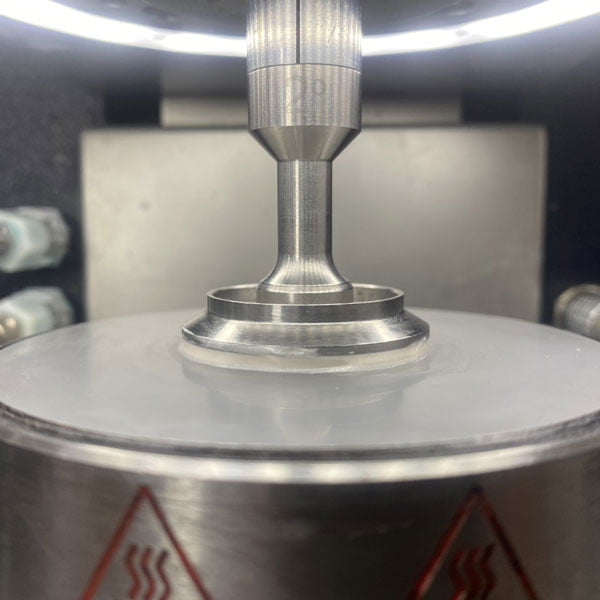
If you want to find out more about our rheology testing for electronics, then read the case studies and articles below.
Electronics Materials Case Studies and Articles
















The Methods We Use
Relevant Techniques
You can learn more about how we measure the rheology of sensor materials, conductive coatings, and other materials by following the links below: