
Want to know how we help others in your industry?
What is Capillary Rheology?
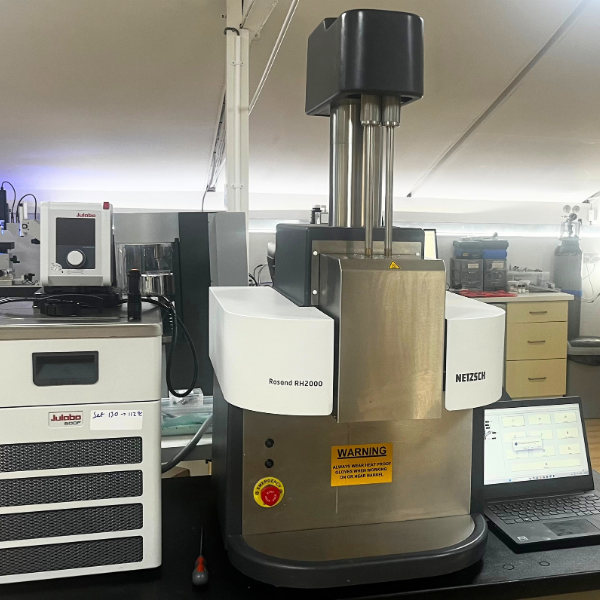
The measurement of shear viscosity, extensional viscosity, and extrusion properties by driving a sample through a fine capillary, from ambient temperature up to 400°C.
Uses & Applications
Capillary rheometer measurements add a powerful capability to the toolkit of characterisations available for product developers and process designers.
Capillary rheology is particularly valuable for characterising materials subjected to high shear processes such as extrusion, injection moulding and spraying.
What we do
Our capillary rheology measurements can help you:
Measure viscosity at extremely high shear rates, beyond the reach of rotational methods
Obtain extensional viscosity through twin-bore measurements
Predict processing, filling, handling and application behaviour
Understand structure change following a high-shear conditioning step
Do you need high shear analysis for your samples?
Why use capillary rheology?
High shear rate viscosity measurements
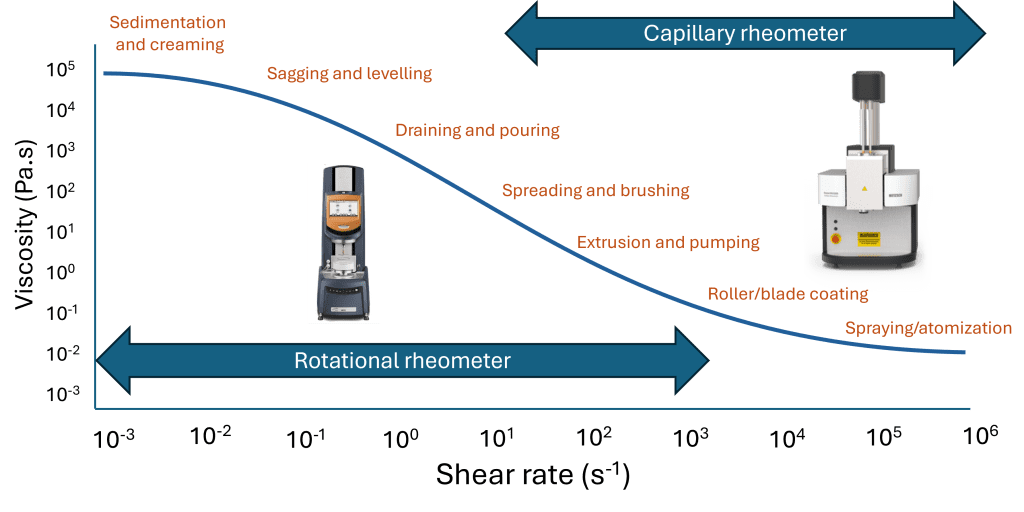
Capillary rheometers enable the measurement of viscosity at far higher shear rates than those obtained through rotational methods employing cone/plate, parallel plate and concentric cylinder measuring systems, where centrifugal sample expulsion and secondary flows limit applicable shear rates. Whilst many rotational methods will top out at shear rates of 5000s-1 or so, capillary rheometers can regularly achieve shear rates in excess of 100 000s-1 throughout measurements.
Why use capillary rheology?
“Difficult” Samples
Rotational methods are often beset with measurement artifacts. Notably with pastes and waxy samples, cone/plate and parallel plate methods suffer from sample fracture and edge failure, where the sample between the plates effectively splits into an upper and lower sample mass, with a pronounced gap at the perimeter of the sample and a highly-localised shear field that does not extend through the entire sample. Capillary rheometers can largely avoid these issues.
Why use capillary rheology?
Extensional Viscosity
Twin bore capillary rheometers enable the measurement of extensional viscosity. Extensional flows, despite their ubiquity, are measured far less frequently than shear flows. Anytime a fluid layer or stream is stretched – such as when entering an orifice, pinched into droplets under atomisation or squeezed between approaching surfaces – extensional or elongational flows occur. Extensional, or elongational, viscosity is the resistance to such flows. With Newtonian liquids the relationship between extension and shear viscosity is a simple 3:1 ratio (the Trouton ratio) however significant deviation from this ratio occurs with, for example, molten or dissolved linear polymers, where shear thinning coincides with extensional thickening.
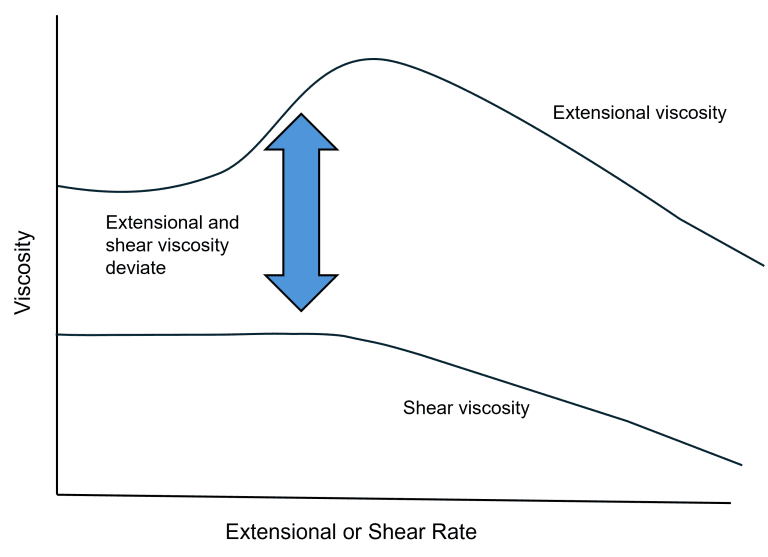
Knowledge of these relative extensional and shear behaviours can predict processing, filling, handling and application properties.
Why use capillary rheology?
High-shear conditioning for rotational rheology
Beyond direct measurement, the capillary rheometer can serve as a high-shear conditioning step prior to standard rotational rheology. By subjecting a sample to a defined, high-shear history through the capillary and then performing conventional rotational measurements, we can observe how the material’s structure has been affected by that high-shear step. This is useful for understanding how products respond to the intense shear encountered in processes such as extrusion, spraying, and high-speed filling, revealing whether the material’s structure breaks down permanently or rebuilds over time.
Upon receipt of your samples, we will:

Measure
Perform appropriate capillary rheology techniques relevant to your products.

Present
Present and explain the results, discussing the insights gained with reference to your specific needs.

Support
Provide the support necessary to exploit the analyses and confidently communicate and discuss the findings.
Other techniques & capabilities
Find out more about our other techniques and capabilities by following the links below.