
Want to know how we help others in your industry?
What is Dynamic Mechanical Analysis?
Dynamic Mechanical Analysis (DMA) characterises the viscoelastic properties of solid materials as a function of temperature or frequency, applying an oscillating stress or strain to measure how a material stores and dissipates energy.
Uses & Applications
Understanding how a solid material responds to stress across a range of temperatures and frequencies is essential for predicting its real-world performance. DMA measurements support research, material selection and quality control across industries, including polymers, coatings, adhesives, composites, pharmaceuticals and personal care.
By measuring properties such as glass transition, damping and relaxation behaviour, DMA helps predict how materials will perform under the mechanical and thermal conditions they encounter in processing and use.
DMA Testing
Dynamic Mechanical Analysis (DMA) Measurement Lab
DMA testing services are a subset of thermal analysis. They’re used to characterise viscoelastic properties as a function of temperature or frequency. DMA investigates and quantifies physical properties like:
Glass transition
Dampening properties
Relaxation properties
Decomposition
It assesses the properties under specific environmental conditions or phase changes like melt, curing or crystallisation.

Time Temperature Technique (TTS)
For materials likely to be subjected to a broad range of temperatures, frequencies or amplitudes, we use TTS. It constructs a master curve that helps us understand the material’s response under extreme conditions, which might not be possible to measure under typical circumstances.
How It Helps You
What is DMA Used For?
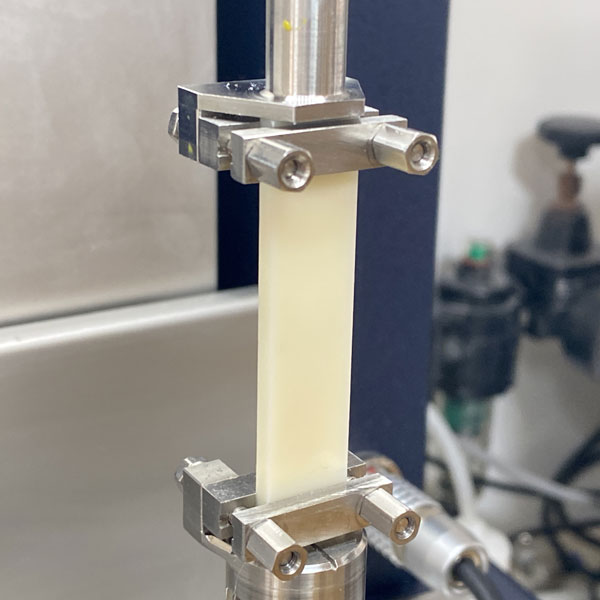
Our mechanical testing lab is frequently used to characterise solid materials in the form of bars, films or rods. Our geometries include disposable plates, cantilevers and film tension grips. They enable us to subject materials to shear, tension and compression.
A Clear Demonstration
An Idealised DMA Plot Against Temperature
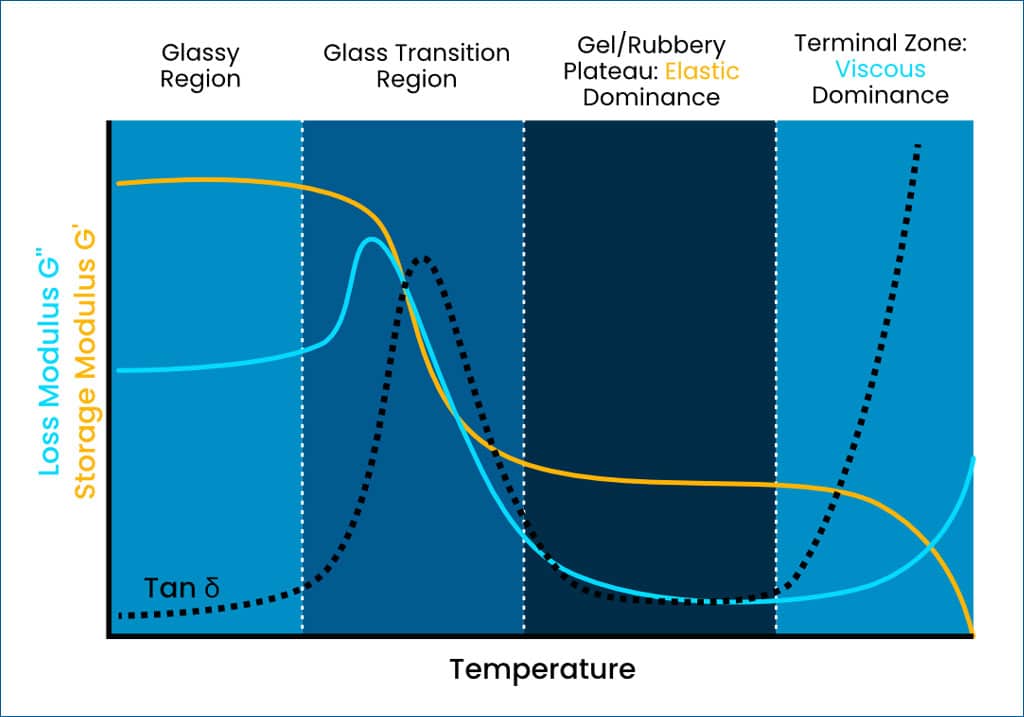
This plot shows storage modulus (yellow), loss modulus (blue) and tan delta (black dashed) as a function of temperature.
Under low temperatures in the glassy state, the material is disordered and in a non-crystalline state. This means it will be rigid and brittle. As temperature increases, the material becomes softer and more flexible, which is marked by a drop in storage modulus and an increase in loss modulus and tan delta.
The rubbery plateau describes a region above the glass transition but below the melt. This is typically seen where polymer entanglement or crosslinking occurs. In this phase, the material exhibits elastic deformations with relatively low stresses. Further increases in temperature may cause phase transition or melt (Tm). The material will then behave more like a viscous liquid.
Want to find out more about dynamic mechanical analysis measurements for your materials?
Get in touch
Other techniques & capabilities
Find out more about our other techniques and capabilities by following the links below.