
Want to know how we help others in your industry?
How we help
Common problems we solve for cosmetics and personal care:
Predict Sensory Properties
Tribo-rheology measures how a cream or lotion flows and lubricates as it is applied to skin. This gives objective, repeatable sensory profiles before a formulation reaches a panel.
Compare Surfactant Foams
Dynamic foam analysis images lather as it forms and decays, tracking volume, drainage and bubble size. Testing at in-use dilutions shows the foam consumers actually see.
Predict Emulsion Stability
Rheology measures the at-rest structure that stops droplets creaming and particles settling. Zeta potential adds electrostatic stability, benchmarking new formulations against established products early.
Quantify Lubricity & Friction
Tribology measures the friction between soft, skin-like surfaces as a product spreads. This turns glide and slip into clear numbers for comparing formulations.
Benchmark Silicone-Free Products
Rheology compares the structure of a silicone-free reformulation against the original. Tribology adds an objective comparison of their sensory properties.
Investigate Filling Issues
Rotational rheology measures normal stress at the high shear rates of pumping and filling. This flags the hidden elasticity behind stringing, poor cut-off and back-pressure.
What We Do
Our Support for Cosmetic Formulators
Our physical characterisation services encompass a range of methods that deliver valuable insights for any formulator or process developer looking to:
Predict sensory properties
Select alternative ingredients
Rapidly assess stability and shelf life
Understand the impact of pumping and filling on product integrity
Reverse engineer a marketed reference product
Common Questions Answered
Challenges and Solutions
Challenge
“How can I replace an ingredient but maintain my formulation’s good sensory properties?”
Solution
Combining rheology measurements (flow properties) with tribology measurements (lubricating properties) enables objective, quantified and repeatable comparisons of formulations for sensory qualities. This reliable instrumental approach reduces dependence on expensive and time-consuming sensory panel tests, allowing product developers to quickly and efficiently screen multiple new ingredients.
Our clients make use of our rheology and tribology testing services when:
- Identifying alternatives to silicones, petrochemicals, etc.
- Selecting rheology modifiers
- Reformulating with alternative emollients and emulsifiers

Challenge
“How can I compare surfactants and the foams they produce?”
Solution
For manufacturers of foaming products, we offer three powerful techniques to support product development:
- Interfacial rheology: The rigidity and elasticity of an air/liquid interface
- Bulk foam rheology: Rigidity and strength of a foam or lather
- Dynamic foam analysis: Foamability and stability measurements
This powerful combination delivers a suite of physical properties the formulator or process controller can leverage when selecting ingredients and predicting consumer satisfaction.
Challenge
“How can I get a rapid prediction of potential emulsion stability problems?”
Solution
Rheology testing can provide useful metrics to rapidly assess the impact of formulation changes that may lead to unstable emulsions, thereby affecting the shelf-life of products such as creams and lotions.
Zero-shear viscosity, yield stress and viscoelasticity all influence the integrity of an emulsion, changes which highlight a propensity to creaming, flocculation or coalescence. Temperature elevation and cycling can accelerate rapid assessments.
Want to find out more about our rheology testing lab for cosmetics and personal care?
What We Analyse
The Physical Properties of Cosmetics
Optimum rheology, tribology, interfacial and foaming properties are prerequisites for success in the demanding arena of cosmetics. Knowledge of critical physical attributes arms the savvy formulator with the tools needed to win in the competitive marketplace of personal care.
About us
Get in touch
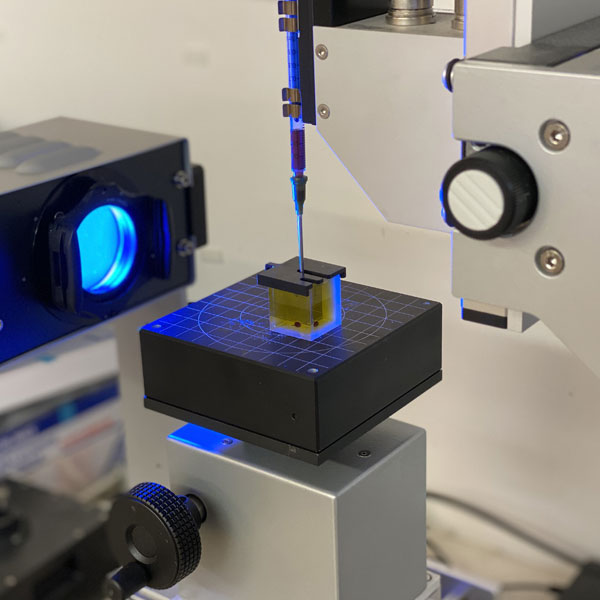
Drop shape analyser
Learn more about how we’ve supported the cosmetics and personal care industry by reading the case studies and articles below.
Cosmetics And Personal Care Case Studies And Articles















The Methods We Use
Relevant Techniques
You can learn more about our capabilities regarding cosmetics, personal care and more by following the links below.