
As a fat cools, crystals nucleate, grow, and link together into a network that traps oil and suspends particles. How quickly that network forms and the structural strength it ultimately reaches govern a product’s texture, stability, and processability
This makes fat crystallisation particularly sensitive to reformulation. Palm-free claims, cost-driven fat swaps, and changes of ingredient suppliers all alter a product’s fat phase, and with it, how the product crystallises. Importantly, two formulations can appear nearly identical when in a melted state yet crystallise very differently upon cooling.
At the Centre for Industrial Rheology, we provide nuanced insights into crystallisation behaviour utilising techniques such as oscillatory rheology. Rather than simply identifying the temperature at which crystals first appear, we track how the underlying structure builds upon cooling.
Why does crystallisation matter for fat-based products?
The crystal network that forms during cooling is responsible for much of a fat-based product’s physical behaviour, from the factory production line right through to the consumer:
- Processing – How quickly a product crystallises can influence cooling tunnel residence times and how long a product remains mobile after hot-filling.
- Stability – The fat crystal network acts like a microscopic sponge, using capillary forces to lock oil in place while suspending dense solids such as sugar and cocoa. A weaker or slower-forming network can allow these solids to sediment during cooling and oil to migrate to the surface over shelf life.
- Texture – The final structure of the crystal network strongly influences initial firmness, spreadability and the texture that consumers experience.
Understanding not only when a product crystallises, but how its structure develops, is therefore key to reformulating with confidence.
Get in touch to learn how our expertise can support your product development
How do you measure crystallisation with oscillatory rheology?
Many formulators in the confectionery space will be familiar with the Casson flow curve. While these are extremely valuable for characterising melted behaviour, taking insights far beyond single-point viscometer readings, they rely on continuous rotational shear. If applied during cooling, this rotational shear would break up the crystal network as it forms, changing the very thing being measured.
Oscillatory rheological methods can be used to probe this delicate structure. These methods involve applying small oscillatory deformations to a sample, which can be thought of as gently wobbling the sample to observe how its structure responds. A key variable derived from this method is the complex modulus, which describes a sample’s overall resistance to deformation. This is essentially the rigidity of the sample.
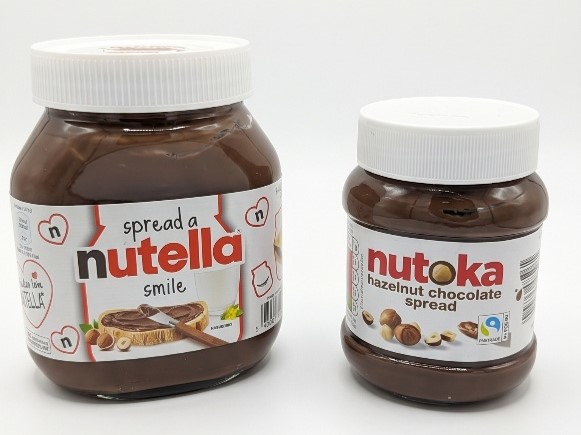
To demonstrate the insights gained through oscillatory rheology for fat crystallisation, we characterised two hazelnut spreads, Nutella and Aldi’s Nutoka. Each sample was held at 50 °C for 10 minutes to ensure a fully melted fat phase, before the temperature was rapidly stepped down to 10 °C and the modulus was tracked for a further 20 minutes as the fats crystallised.
Results – Nutella vs Nutoka
Understanding A Rheological Crystallisation Profile
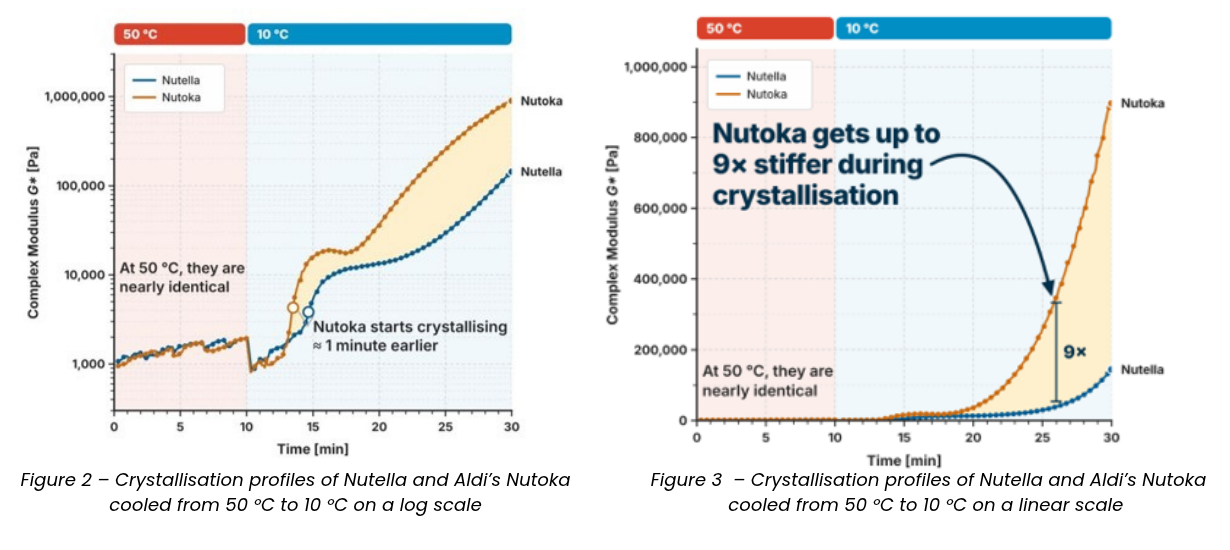
Figures 2 and 3 illustrate the crystallisation profiles of both spreads, highlighting several distinct structural phases that occur as a fat crystallises. While held at 50 °C, the fat phase is fully melted. The complex modulus settles at a low, stable baseline, reflecting mainly the background contribution of solid particles such as sugar and cocoa suspended in oil.
Once the temperature is stepped down to 10 °C, the sample begins to cool, and crystal nuclei start to form. Initially, these crystals are too few and isolated to interact, so the modulus changes very little. As further crystals nucleate and grow, they interlock into a space-filling network, and the modulus rises steeply. The steepness of this climb reflects how quickly the structure develops.
As fats are mixtures of many different components, they don’t all crystallise at the same rate, and their crystals can also rearrange into more stable forms over time. This can produce a two-stage profile like the one seen in both products, where the modulus levels off at an intermediate plateau before climbing a second time. Together, these stages provide a characteristic crystallisation fingerprint, allowing products to be compared beyond just identifying when crystals form.
Nutella vs Nutoka: How did they crystallise?
During crystallisation, Nutoka became up to 9 times stiffer than Nutella
When melted, Nutella and Nutoka’s complex modulus was nearly identical
The true formulation differences only emerged as the fats crystallised
Nutoka crystallised earlier and faster at every stage
These timings affect how quickly texture and structure develop in the crucial minutes immediately after filling during manufacturing
| Measurement | Nutella | Nutoka |
|---|---|---|
| Complex modulus when melted (50 °C) | 1.9 kPa | 1.9 kPa |
| Crystallisation onset (after cooling began) | 4.7 minutes~1 minute after Nutoka | 3.5 minutes~1 minute before Nutella |
| Time to reach 10 kPa | ~6.5 minutes | ~4 minutes |
| Complex modulus at end of test | 140 kPa | 890 kPa |
Summary
Whether reformulating to achieve palm-free claims, navigating raw material cost pressures, or qualifying an alternative fat supplier, predicting how your product will behave on the cooling line or in the jar requires more than just basic measurements on melted samples.
As demonstrated by Nutella and Nutoka, two products with nearly identical high-temperature rheology can diverge dramatically within minutes of cooling. By capturing this characteristic crystallisation fingerprint through oscillatory rheology, formulators can benchmark candidate blends against a target profile, helping confirm that new formulations match the processing window, oil-binding stability, and indulgent texture that consumers expect. If you would like to explore how our expertise can support your product development, do not hesitate to contact us.
Frequently Asked Questions:
Can two products with the same melted viscosity crystallise differently? Yes, as seen in this article, Nutella and Nutoka had the same complex modulus when melted; however, Nutoka became up to 9 times more rigid during cooling.
Why use oscillatory rheology rather than rotational tests or Casson flow curves for crystallisation? Rotational tests apply continuous shear, which breaks the crystal network as it forms. Oscillatory tests use small deformations that measure the delicate structure present within samples without destroying it.
Who can test fat crystallisation behaviour? The Centre for Industrial Rheology uses rheology to measure fat crystallisation behaviour for food and confectionery manufacturers.