
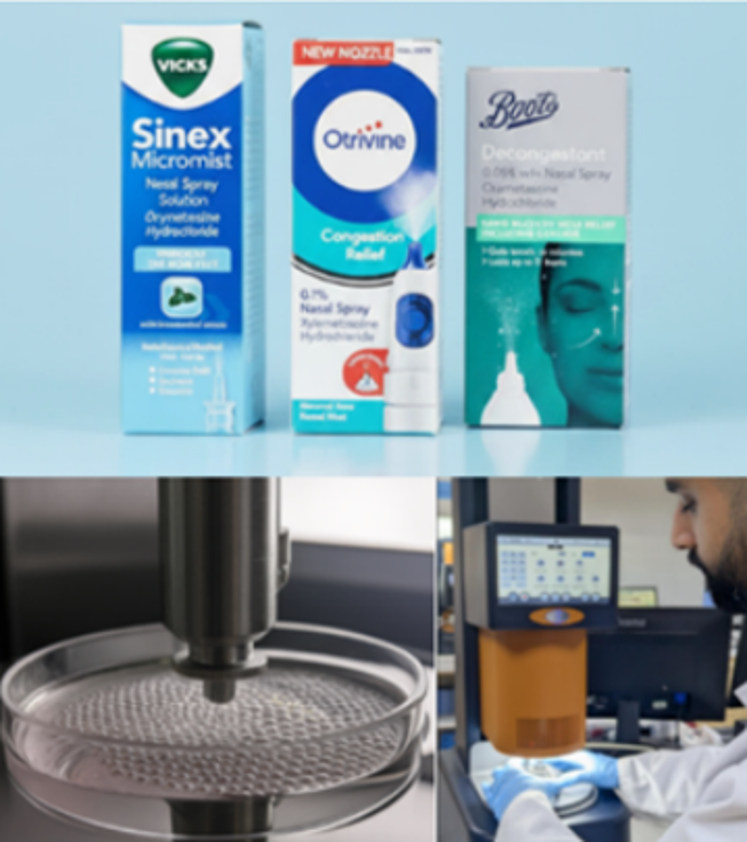
At the Centre for Industrial Rheology, we’ve bundled our most essential testing capabilities for the optimisation of nasal sprays below.
The efficacy and overall consumer experience of a nasal spray is not solely determined by the active ingredients used. To ensure a drip-free, finely atomised spray that provides prolonged relief, advanced analytical testing of the full formulation should be carried out.
Contact us now to speak with the experts
| Analytical Test Method | Insights Gained | Why These Insights Matter for Nasal Sprays |
|---|---|---|
| Dynamic Surface Tension using the Maximum Bubble Pressure Method | Capturing surface tension at timescales of milliseconds, analysing surfactant kinetics | Used to explore timescales relevant to spraying (below 200 milliseconds) to explore droplet breakup, wetting behaviour and investigate dripping issues |
| Controlled Rate Viscosity Profile | Characterising viscosity over a wide range of shear conditions, aimed at capturing any non-Newtonian behaviour | Validates that the high-shear viscosity is low enough for optimal droplet formation |
| Thixotropic Recovery Analysis | Measuring the rate at which viscosity recovers after a high-shear step | Used to explore a non-drip profile for non-Newtonian formulations |
| Mucoadhesion Benchmarking | Capturing mucoadhesion by investigating any synergistic interaction between the formulation and mucin | A synergistic interaction indicates mucoadhesive behaviour, which will impact residence time and drug adsorption, providing prolonged relief |
Capturing Dynamic Surface Tension for Nasal Sprays
For applications such as spraying, it is essential to capture surface tension at relevant timescales, generally between 20 and 100 milliseconds. This is not capturable through optical or force tensiometer methods. Table 2 below shows the key stages and the desired dynamic surface tension profiles for formulations such as nasal sprays.
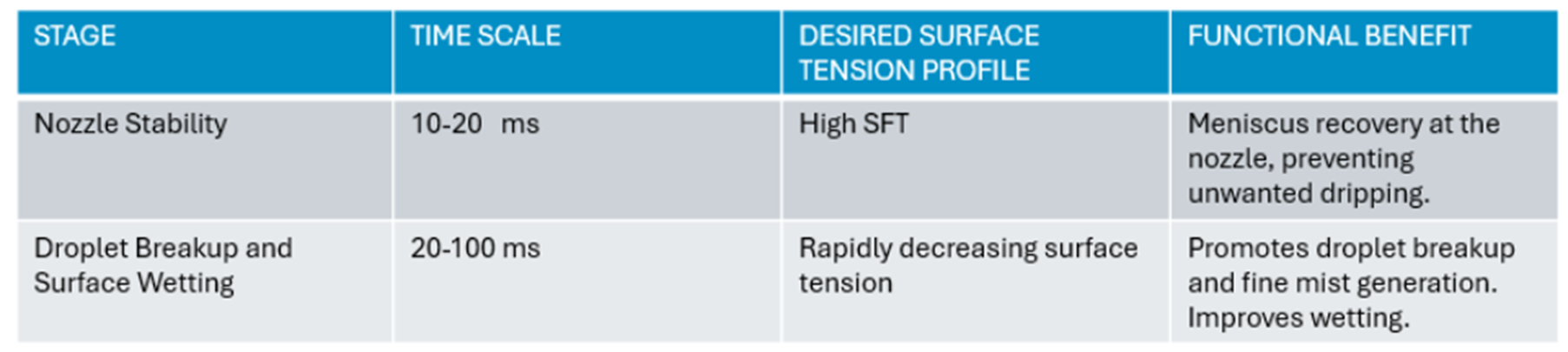
Dynamic surface tension measurements can be extremely useful to explore dripping issues at the nozzle following actuation, from the nose post-deposition or even down the throat. As shown in Table 2, an ideal nasal spray formulation should exhibit high surface tension at 10ms to ensure the meniscus at the nozzle remains stable. To promote “no-drip” performance once deposited in the nose, however, surface tension must decrease rapidly to facilitate fine mist generation and effective wetting on nasal mucosal surfaces.
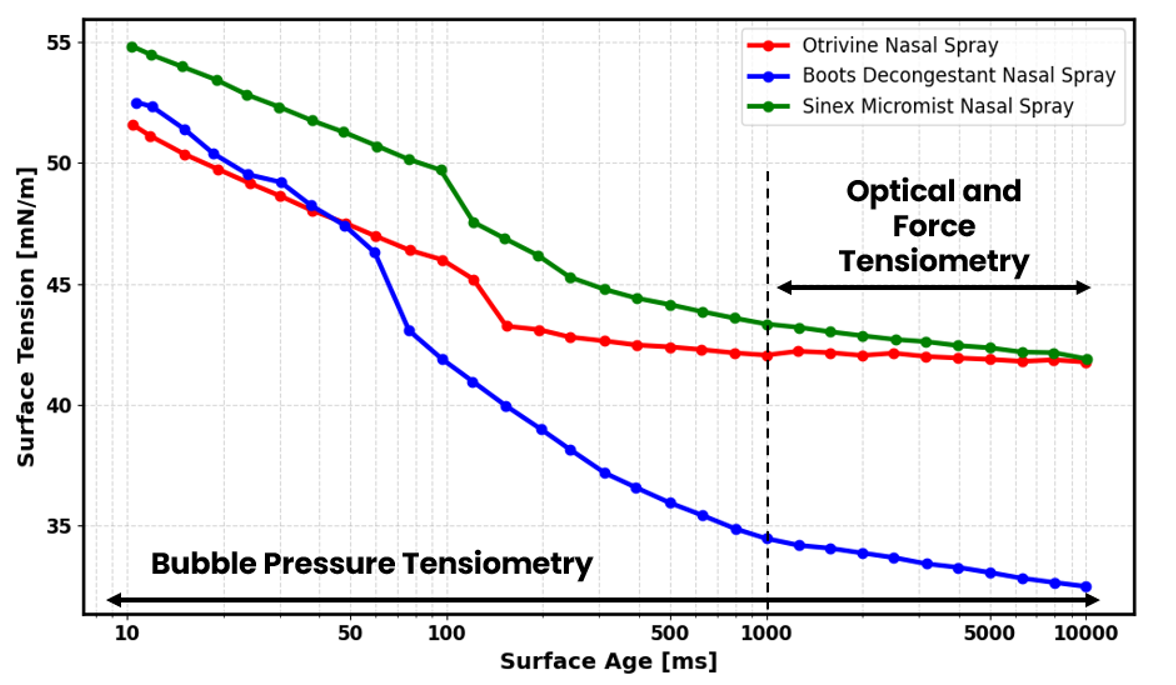
The results obtained demonstrate clear differences in the dynamic surface tension profiles between all three samples. At a surface age of 10ms, all samples maintain values above 50 mN/m, with Sinex Micromist exhibiting the highest value at 54.85 mN/m. This is consistent with the requirement for preventing premature meniscus destabilisation at the nozzle.
Boots Decongestant exhibits the most pronounced reduction in dynamic surface tension. This reduction in dynamic surface tension reflects the mobility of surfactants present within the formulation and can aid in subsequent wetting of nasal surfaces. In contrast, both Otrivine and Sinex equilibrate at much higher values, suggesting less effective wetting compared to Boots.
Utilising a Rheometer to Test Viscosity for Nasal Sprays
Our suite of high-performance research rheometers offers the sensitivity, speed, and torque range required to characterise low viscosity formulations, as well as attaining higher shear rates that are more relevant to spraying processes. Utilising a rheometer is particularly relevant if thickening or mucoadhesive polymers are incorporated within a formulation, as this can lead to non-Newtonian behaviour which cannot be adequately captured when utilising basic viscometers.
When viscosity is below 3×10⁻³ Pa·s, viscous contributions to spraying are minimal [1]. In this case, surface tension effects dominate and heavily influence droplet formation. However, if viscosity is above this value, then viscous effects become more significant. This affects sprayability through suppression of Rayleigh instabilities and inhibition of droplet pinch-off, leading to poorer atomisation.
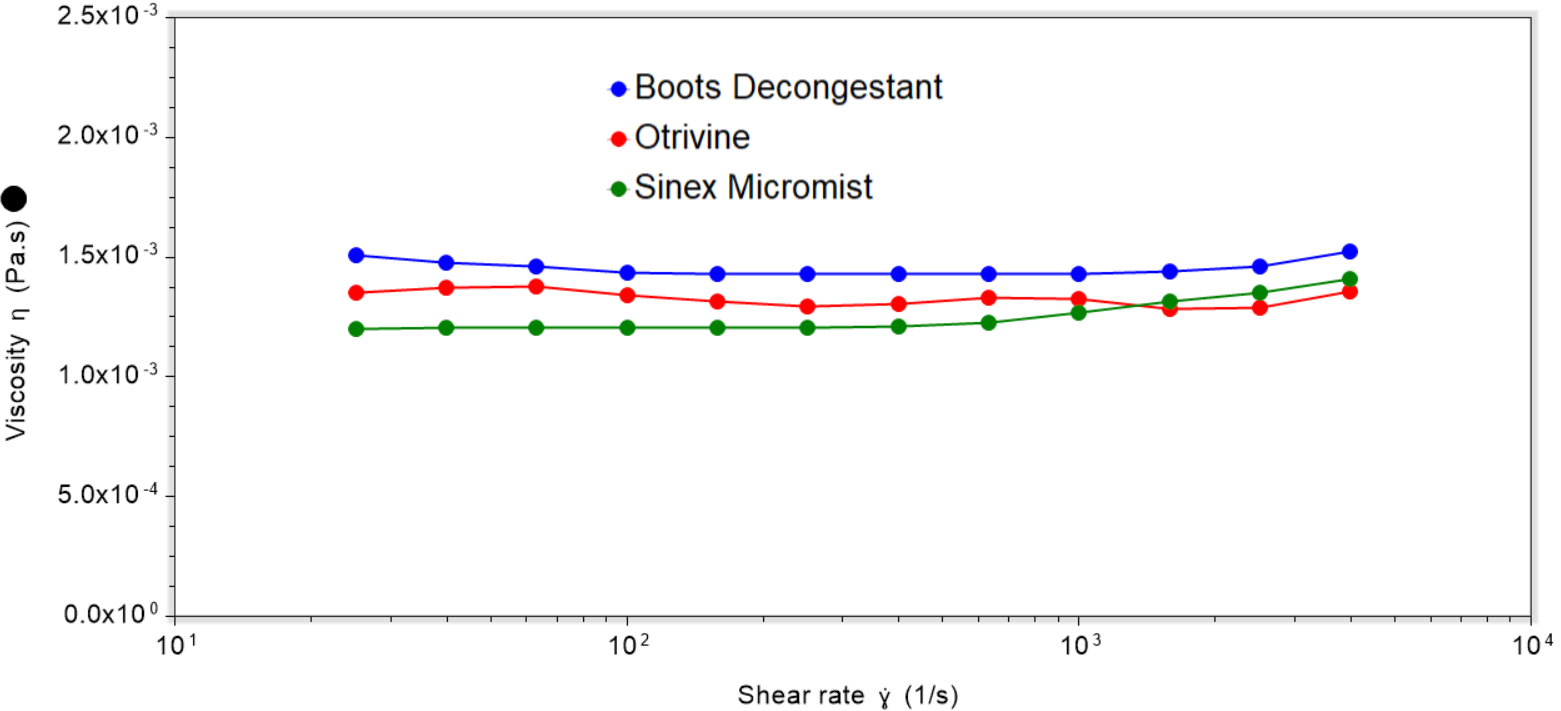
The results captured show that all samples display similar viscosity values, around 1 x 10⁻³ Pa·s, with Newtonian behaviour. The small increases observed at higher shear rates occur due to turbulence or secondary flows and are a measurement artefact. It should be noted that if non-Newtonian behaviour is observed, it is important to ensure that viscosity is sufficiently low at higher shear rates to avoid adversely affecting sprayability.
Thixotropic Analysis for Nasal Sprays
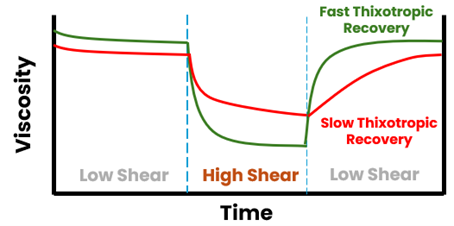
In the case of non-Newtonian fluids, thixotropic failure can also contribute to observed dripping from the nose or down the throat. Thixotropy describes the time-dependent change in viscosity following either the application or cessation of shearing. If thixotropic recovery occurs too slowly, the liquid will remain in a low-viscosity state for longer post spraying. This can contribute to a greater tendency to gravitational runoff, contributing to observed dripping.
Benchmarking Mucoadhesion for Nasal Sprays
Mucoadhesion reflects the ability of a material to adhere to mucosal membranes and is an extremely important functional property for nasal sprays. To assess mucoadhesion, we examine how a rheological metric, such as viscosity, changes when mucin, the key glycoprotein component of mucus, is introduced to a sample.
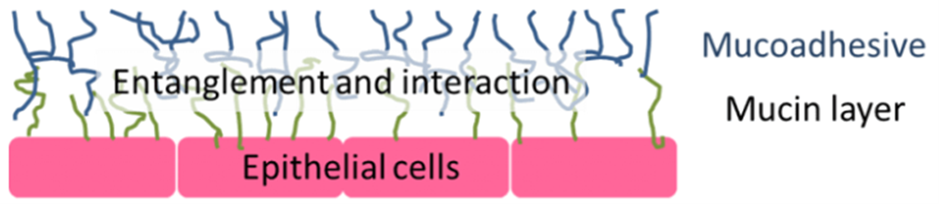
Some combinations of mucoadhesive polymers and mucin demonstrate a marked increase in viscosity. This increase in viscosity demonstrates the synergistic interaction between the product and mucin, contributing to mucoadhesion. In a real-world scenario, this translates to a product that is more likely to stay applied on the nasal mucosa, delivering prolonged relief. For formulators, this means better control over soothing agent delivery whilst providing a scientifically backed claim to lasting relief.
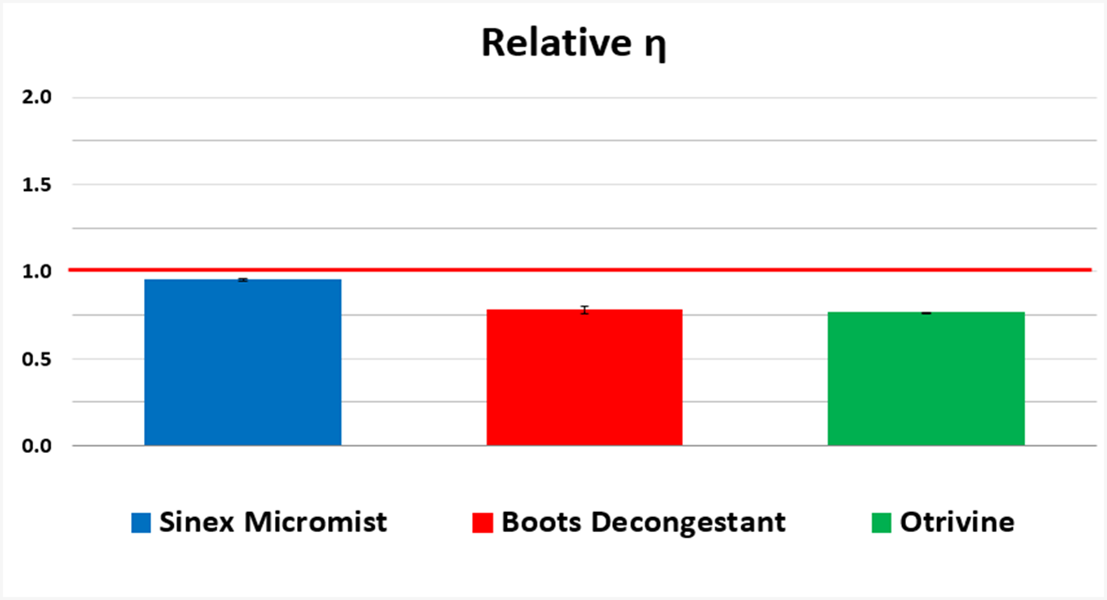
As expected, based on the observed non-Newtonian behaviour of all samples in this study, there was a negative interaction with mucin identified, signalling no mucoadhesive behaviour. This highlights a potential opportunity for formulation optimisation for these nasal sprays. By incorporating mucoadhesive polymers, formulations can be further engineered to adhere to the nasal mucosa, extending the vasoconstrictive effect on underlying blood vessels.
This may also present an opportunity for utilising a lower concentration of active ingredient to save costs, on top of enhancing consumer perception. However, this transition must be carefully balanced; any increase in mucoadhesion should be cross-referenced with viscosity and dynamic surface tension profiles to ensure that the enhanced retention does not come at the expense of sprayability.
Summary
As a comprehensive testing lab, we provide extensive characterisation services that extend beyond our core rheological expertise. By utilising a suite of complementary techniques, we offer a holistic view of formulation performance that basic testing often overlooks.
If you are looking to optimise your products further, we provide rapid access to the essential data required to make evidence-based formulation decisions. Contact us to see how our analytical expertise can help support your development goals.
References
[1] – Chideme N, De Vaal PL. Effect of liquid viscosity and surface tension on the spray droplet size and the measurement thereof.

Related Articles;
Rheology for Mucoadhesion Studies
Dynamic Surface Tension Characterisation at Short Surface Ages
Wasif Altaf serves as an Applications Specialist at the Centre for Industrial Rheology, leveraging a chemical engineering background (BEng) to bridge theory and practice. His work focuses on advanced rheological characterisation.