
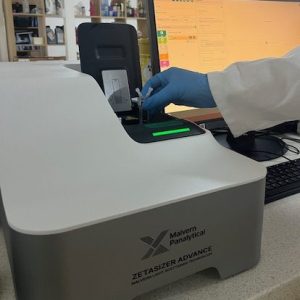
Dynamic light scattering is a versatile, non-destructive analytical technique used to determine particle size distribution, polydispersity index, and hydrodynamic diameter. Equipped with a top-of-the-range Malvern Zetasizer Advance Ultra Red, we can carry out both standard dynamic light scattering and multi-angle dynamic light scattering. With a capturable particle size range of 1 nm to 15 μm, dynamic light scattering is indispensable for characterising proteins, nanoparticles, emulsions, and polymers across industries ranging from pharmaceuticals to cosmetics. Beyond sizing alone, dynamic light scattering serves as a critical tool for stability analysis; its high sensitivity allows for the early detection of aggregation, even as a function of temperature.
How Dynamic Light Scattering Works
When a laser is directed through a sample, particles in suspension scatter the light in all directions. Because particles in suspension undergo continuous, random Brownian motion, the intensity of scattered light fluctuates over time. Dynamic light scattering captures these fluctuations and uses them to calculate a diffusion coefficient, which is then converted into a hydrodynamic diameter via the Stokes-Einstein equation. Smaller particles diffuse rapidly and produce fast fluctuations, while larger particles diffuse more slowly and produce slower fluctuations. This allows size to be inferred directly from the dynamics of the scattered light.
Contact us to find out how dynamic light scattering testing can support your formulation work
Particle Size Distribution and Polydispersity Index Measurements
Particle size distribution describes the range of particle sizes present within a sample and the relative proportion of each. This reveals whether a sample is dominated by a single, narrow population or whether multiple populations of different sizes are present. This is particularly important for formulations such as emulsions, protein solutions, and nanoparticle suspensions, where the presence of even a small population of larger particles or aggregates can have a significant impact on performance and stability.
In addition to particle size distribution, we can assess the homogeneity of a sample through the polydispersity index. This dimensionless number, derived from the correlation function, effectively reveals the breadth of the particle size distribution. In practical terms, the polydispersity index tells us whether the particles in a solution are roughly uniform in size, or whether they span a wide range.
The polydispersity index is scaled from 0 to 1. Values closer to 0 indicate a monodisperse sample in which particles are highly uniform in size. Values approaching 1 suggest a broad or polydisperse distribution, signalling that the sample may be non-uniform and could contain large aggregates, contaminants, or multiple distinct particle populations.
These measurements serve as a powerful predictive tool for stability and batch-to-batch reliability. A shift toward a higher polydispersity index is often the earliest warning sign of a formulation failure. In proteins and polymers, for example, instability frequently manifests as random aggregation; polydispersity index measurements are sensitive enough to capture these subtle changes well before they become visible through other means. An example of a typical output from these measurements can be seen below.
Multi-Angle Dynamic Light Scattering Measurements
Standard dynamic light scattering measurements collect scattered light at a single fixed angle, which can limit the technique’s ability to distinguish between particle populations that are close in size. Our Zetasizer Advance Ultra Red is equipped to perform multi-angle dynamic light scattering, collecting data simultaneously at three angles, backscatter, side-scatter, and forward scatter. By combining these datasets, MADLS reduces measurement noise and extracts significantly more information from the sample, improving size resolution from a 3:1 ratio down to approximately 2:1.
In practice, this means that samples containing multiple particle populations of similar size are far more likely to be resolved as distinct peaks, rather than appearing as a single broad distribution that could be misinterpreted.
The data above illustrates the difference in output between standard DLS and MADLS measurements. It can be seen that MADLS successfully resolves multiple populations that were not well characterised through standard DLS, specifically highlighting a population at 1.2 nm that was not seen previously.
Summary
Dynamic light scattering is one of the most powerful and accessible tools available for particle characterisation and early-stage stability assessment. Whether you require a rapid polydispersity index screen or a high-resolution MADLS measurement to resolve complex particle populations, our Malvern Zetasizer Advance Ultra Red provides the sensitivity and versatility to deliver meaningful data with a rapid turnaround. Contact us to discuss utilising dynamic light scattering techniques for your samples.