
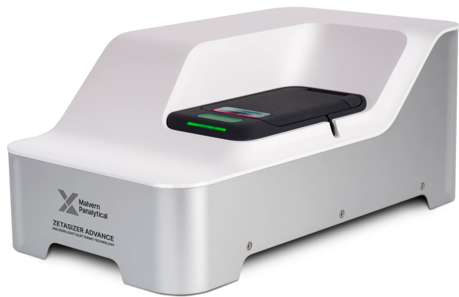
We have now added Dynamic Light Scattering (DLS) and Zeta Potential (ZP) measurements to our rapidly expanding repertoire of complementary and synergistic sample testing capabilities.
Both in isolation and combined with rheology and interfacial measurements, these bring a whole new set of materials insights within easy, accessible reach for the researcher or formulator.
What is Dynamic Light Scattering?
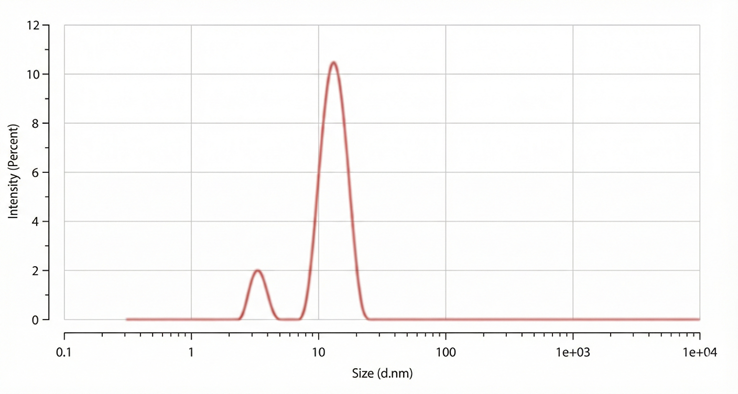
Dynamic Light Scattering (DLS) is a powerful technique that enables the characterisation of particle size, polydispersity, hydrodynamic radius, and particle concentration of a range of materials.
The technique is of particular relevance to:
- Suspensions, emulsions, and other dispersions
- Polymers, proteins, and oligomers
- Lipozomes and lipid nanoparticles (LNPs)
- Micelles and vesicles
- Carbon nanotubes
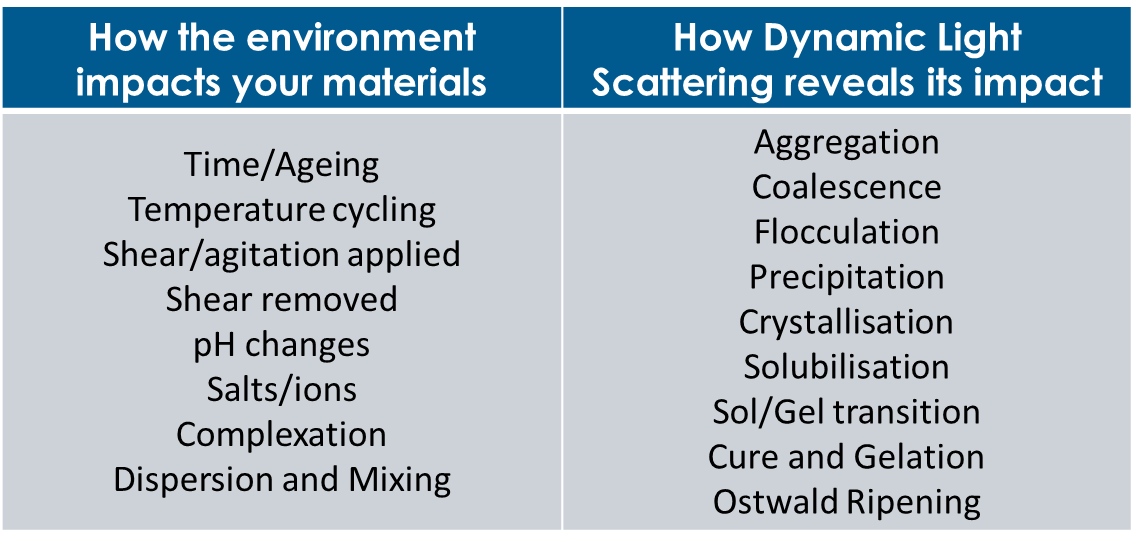
Dynamic light scattering can shed light on a host of transitions your materials may go through depending on their environment.
These impacts include:
Contact us to discuss your requirements
Contact us
What are zeta potential measurements, and how can I use them?
Zeta potential measurements add a whole new dimension to the DLS technique by monitoring electrophoretic mobility. By applying a charge and monitoring how fast particles move in the electric field, we can calculate the charge on a particle. Zeta potential is the electrostatic potential at the slipping plane, the boundary between the diffuse charge cloud and the tightly attached “Stern” layer.
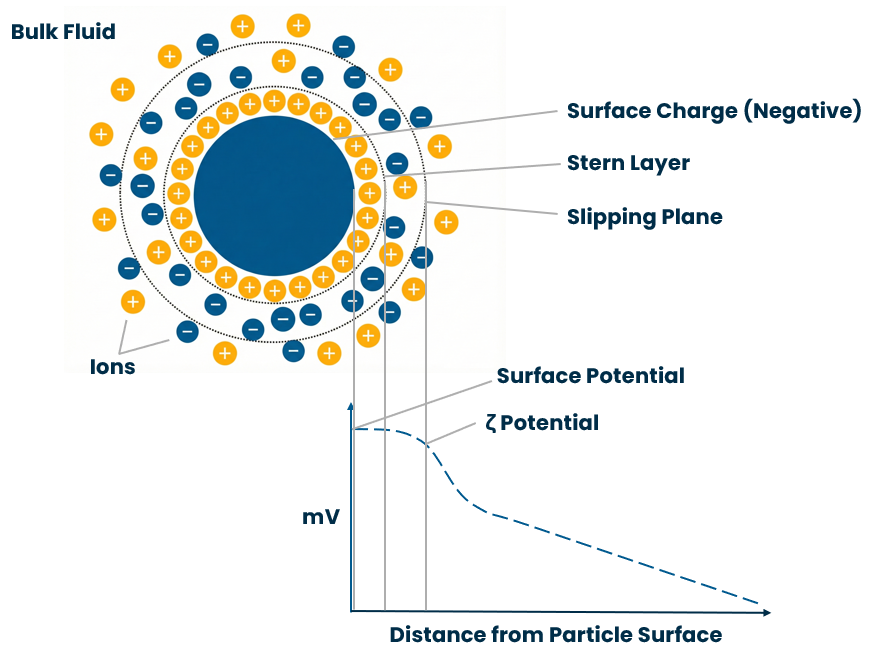
Zeta potential is the go-to method for assessing electrostatic stability. The closer the zeta potential to 0mV, the more likely the dispersion is to be electrostatically unstable. This may be a good thing if you need to induce flocculation or aggregation, but many times it is detrimental to product storage and performance. In those cases, an alternative stabilisation strategy will be necessary.
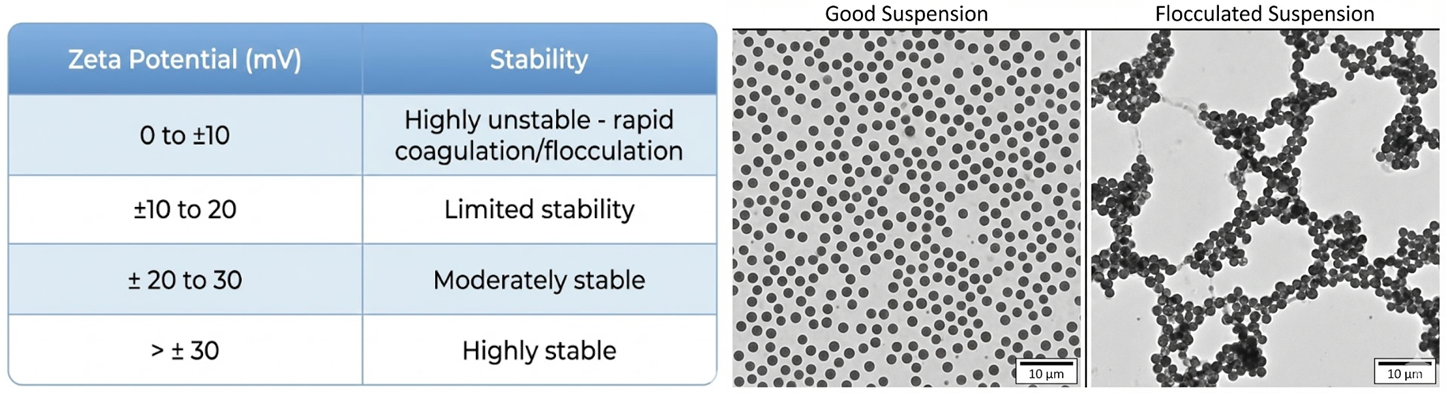
Stabilising strategies could then include:
- Increasing the external phase zero-shear viscosity
- Imparting structure and yield stress, or adding sterically adsorbing polymers to the particles to maintain separation
- Wrapping a robust elastic interface around the emulsified droplets
Dynamic Light Scattering and Zeta Potential Measurements add a new dimension to particle and dispersion characterisation methods. When combined with rheological and interfacial measurements, DLS/ZP characterisations demonstrate both the “how” and “why” of dispersion behaviour beautifully.