
We provide a fast-turnaround surface tension testing and wetting analysis service for your samples.
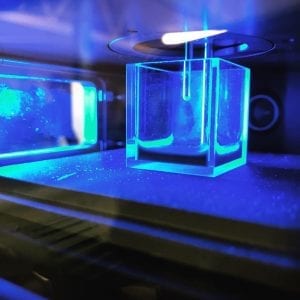
We can provide measurements of surface tension and hydrophobicity or hydrophilicity of a surface or liquid as a function of time and/or temperature. On completion of our testing you will receive a full written report with graphical and numerical results and explanatory notes.
We are an expert measurement lab and any support you may need from us regarding the relevance, interpretation or application of the results we provide is all included in the initial cost of the testing.
Get a quick quote
Surface tension measurements for wetting properties
From simple measurements of equilibrated surface tension to more complex time-dependent or temperature-dependent relationships, we have a host of accessories which enable us to tightly control the conditions of measurement for your sample.
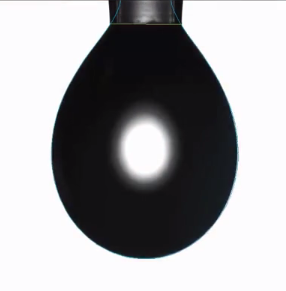
Maximum Bubble Pressure Method
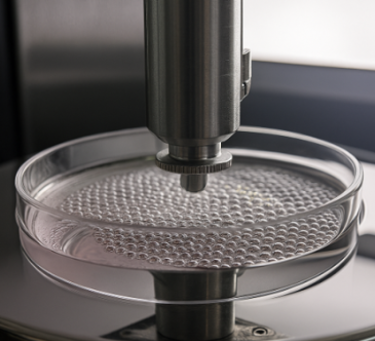
Using the maximum bubble pressure method, we can measure dynamic surface tension from surface ages as short as 5 milliseconds. In this method, a gas bubble is formed at the tip of a fine capillary immersed in a liquid. As the bubble grows, its curvature changes and the internal pressure rises to a maximum Laplace pressure, directly linked to the surface tension at that instant.
Pendant drop analysis is limited to surface ages of approximately one second onwards, which can miss critical insights into surfactant kinetics. This is particularly relevant for dynamic and high-speed processes such as spraying, printing, coating and foaming, where optimising how quickly surfactants migrate to newly formed interfaces to reduce surface tension is essential.
Interfacial Rheology Measurement
Interfacial rheology is an exciting and relatively new technique that enables the characterisation of viscoelastic properties of an interface such as modulus and stress relaxation. These properties arise from the time-dependent interchange of surface active entities between the bulk solution and the interface. As interface is created surfactants take a finite time to adsorb to an equilibrium condition; if the interface is then compressed those surfactants are then forced back into the solution.
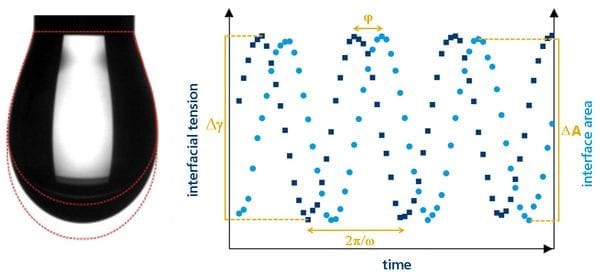
By oscillating the size of a pendant drop and measuring the interfacial tension throughout it is possible to characterise these processes. This method is known as dilatational interfacial rheology.
Contact us now to discuss your specific challenges.