
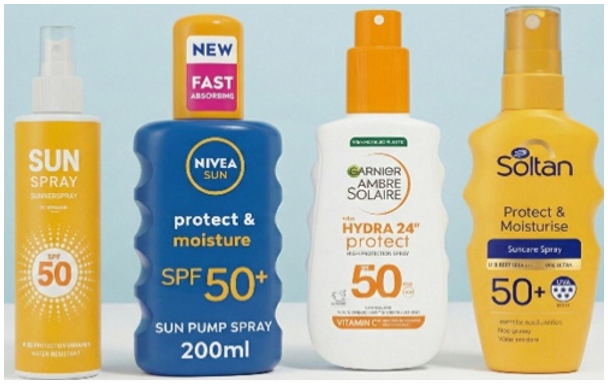
 Effective sun cream sprays require more than just high SPF; they require a formulation that can be easily sprayed and retained on the skin whilst being stable at rest in the bottle. Whilst we have previously characterised the rheological and interfacial contributions to stability at rest, this study focuses on further understanding the spraying behaviour of four leading commercial sun cream sprays.
Unlike traditional creams, the spray sunscreen delivery method presents a unique rheological compromise. The formulation requires sufficient structure at rest to prevent phase separation on the shelf, yet it must reduce in viscosity under the high shear of a nozzle to effectively spray into a fine mist.
All of this needs to be balanced with an optimised dynamic surface tension profile. By utilising the maximum bubble pressure method, we can characterise dynamic surface tension at surface ages that are actually relevant to spraying performance.

Learn more about how we can support your product development
Suncream Spray Dynamic Surface Tension Measurements
Optical and force tensiometer methods are most commonly used with sunscreen samples. However, for formulations that undergo fast timescale processes such as spraying, methods must be adapted. This is due to optical tensiometry taking around a second to equilibrate and take the first measurement. This misses the millisecond timescales that really matter for spraying processes. It is desired for dynamic surface tension to reduce as quickly as possible as soon as a new interface is created. This signifies how fast surface-active molecules diffuse and adsorb at these newly created interfaces to stabilise a droplet and impart better wetting characteristics.
With this sample set, due to viscosity constraints, the formulations required dilution to 25% concentration, preventing absolute quantification of the neat commercial product. As such, this data serves as a comparative benchmark for surface-active molecule adsorption kinetics, providing insights unavailable through static optical methods. These dilutions were prepared in a beaker and homogenised through magnetic stirring.
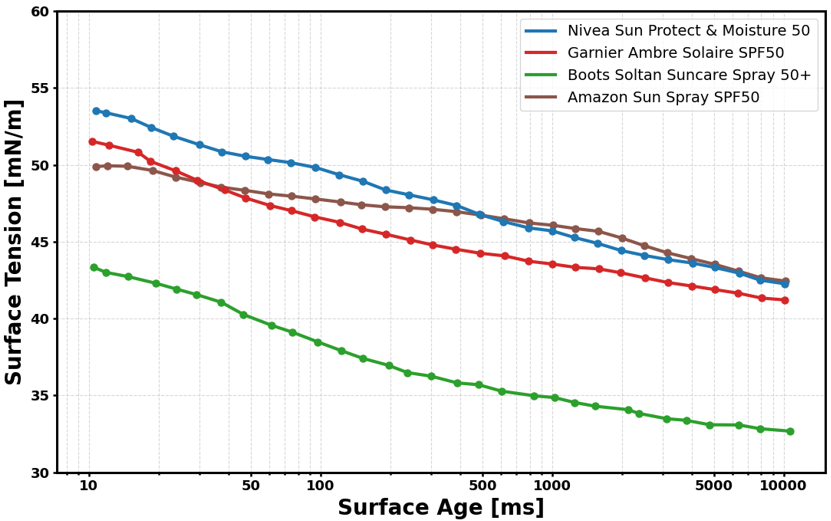
The data shows that Boots Soltan is a distinct outlier, exhibiting a much lower surface tension and a more significant surface tension reduction rate. This suggests that, with respect to surface tension, the Boots formulation is better optimised for sprayability and effective wetting on the skin compared to the other formulations tested. As such, this highlights that carrying out dynamic surface tension measurements at the millisecond timescales relevant for spraying is essential to optimise the sprayability of your formulations.
Suncream Spray Viscosity Measurements
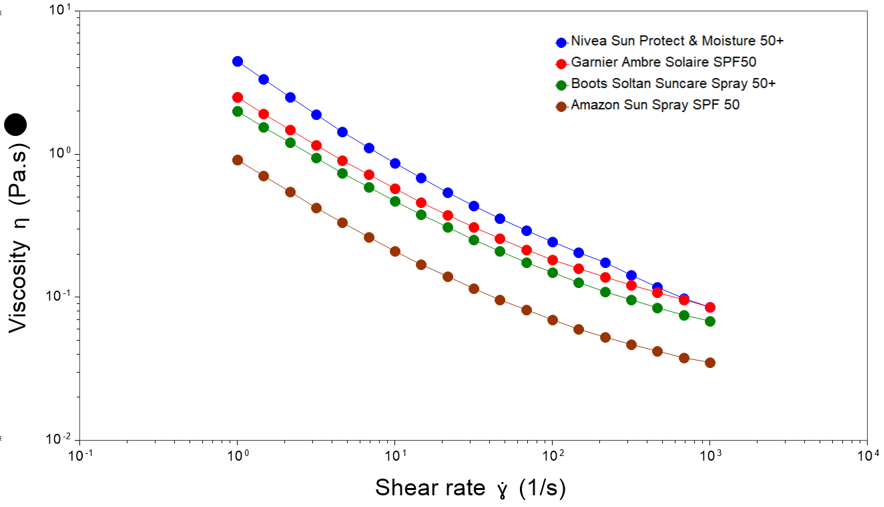
All formulations tested in this study exhibited non-Newtonian shear-thinning behaviour. This means that their viscosity decreases as the shear rate applied increases. This is particularly important in this application, where viscosity is desired to be significantly lower when being sprayed to facilitate droplet formation, compared to when it is at rest in the bottle, where high viscosity is desired for stability. Of this sample set, Nivea exhibited the highest viscosity, while Amazon exhibited the lowest viscosity.
Table 1 – Viscosity Metrics
| Sample | Viscosity at 1s⁻¹ (mPa·s) | Viscosity at 1000s⁻¹ (mPa·s) |
|---|---|---|
| Amazon Sun Spray SPF 50 | 911 | 34.9 |
| Boots Soltan Suncare Spray 50+ | 2005 | 68.5 |
| Garnier Ambre Solaire SPF50 | 2507 | 85.3 |
| Nivea Sun Protect & Moisture 50+ | 4486 | 85.5 |
Thixotropy of Suncream Spray Formulations
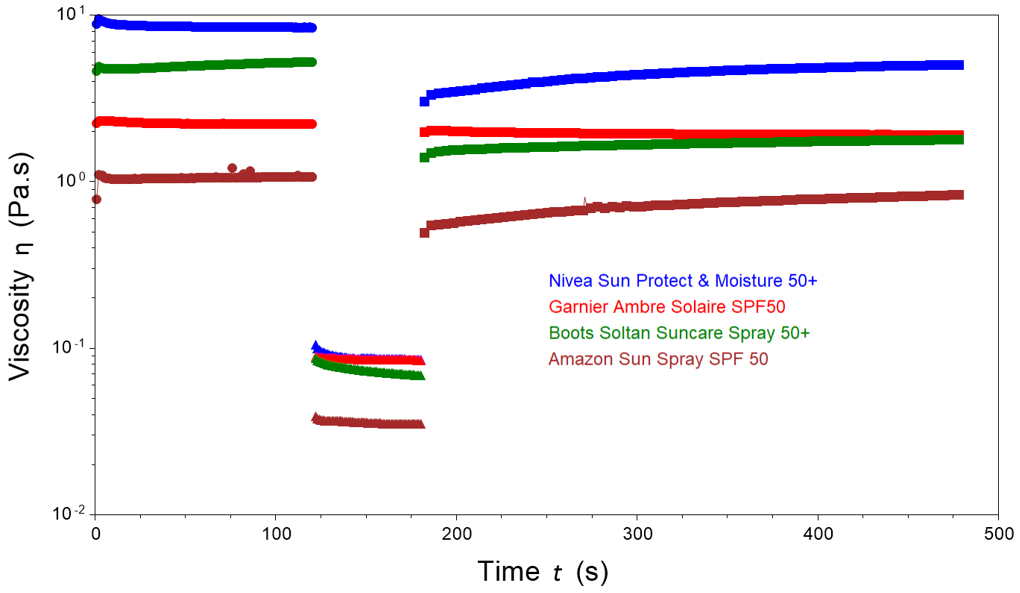
We evaluated each sample’s thixotropy, a time-dependent property detailing how a material breaks down under stress and how it recovers when that stress is removed. Ideally, a sprayable suncream should exhibit a reversible structural breakdown, dropping in viscosity under high shear to facilitate spraying through the nozzle, then recovering viscosity almost instantly upon skin contact to prevent dripping or running.
We applied a three-step rotational thixotropy test, which comprised an initial low-shear phase, followed by a high-shear phase, and finally a return to low shear. All samples exhibited a significant reduction in viscosity under high shear. Following the removal of the high shear step, all samples demonstrated an instantaneous recovery; however, they did not return to their original baselines. Instead, a small time-dependent increase in viscosity was observed, with none of the samples achieving full recovery within 300 seconds.
Table 2 – Thixotropy Metrics
| Sample | Initial Viscosity (mPa·s) | High-Shear Viscosity (mPa·s) | Recovered Viscosity (mPa·s) | Percentage Reduction after High-Shear (%) |
|---|---|---|---|---|
| Amazon Sun Spray SPF 50 | 1070 | 35.1 | 834 | 22.1 |
| Boots Soltan Suncare Spray 50+ | 5240 | 68.6 | 1785 | 65.9 |
| Garnier Ambre Solaire SPF50 | 2226 | 84.8 | 1906 | 14.4 |
| Nivea Sun Protect & Moisture 50+ | 8436 | 85.6 | 5031 | 40.4 |
Summary
The addition of dynamic surface tension data truly differentiated the performance capabilities of these spray formulations. The data indicates that Boots Soltan is the standout formulation; it successfully bridges the gap between the high structural rigidity required for emulsion stability, as shown in our previous study, and the rapid surface-active molecule diffusion needed for optimal droplet formation and wetting on the skin. If you want to fully characterise and understand the performance of your spray formulations, do not hesitate to contact us.

Related Articles:
Rest-to-Spray: Rheology-Driven Prediction of Sunscreen Stability
Predicting Formulation Stability: Advanced Insights for Suspensions and Emulsions
The Secret Factor Ruining Your Spray – Polymer-Induced Normal Stress
Wasif Altaf serves as an Applications Specialist at the Centre for Industrial Rheology, leveraging a chemical engineering background (BEng) to bridge theory and practice. His work focuses on advanced rheological characterisation.