
Challenge
Processing powders such as seasonings under varying global climates remains a persistent challenge for multi-national food manufacturers due to variations in relative humidity and temperature.
Humidity can significantly influence moisture uptake, leading to powders joining together as a cohesive mass. This can cause equipment blockages, product waste, and uneven seasoning distribution.
Without understanding how a powder behaves under the humidity conditions it can encounter in production, process parameters and flow aids cannot be reliably specified, and performance cannot be guaranteed across different sites or seasons.
Solution
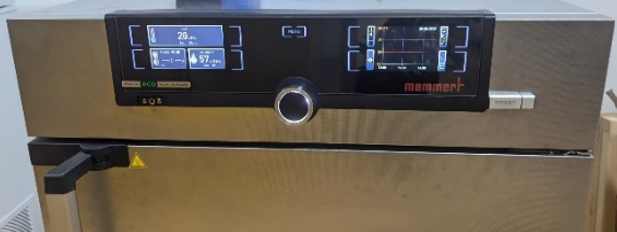 To assess the impact of humidity on powder flowability, we can condition a seasoning powder across a range of humidity levels and temperatures using our climatic chamber, allowing controlled and reproducible exposure to each condition. In this study, we focused on:
- 20% Relative Humidity – representing dry, arid climates such as Arizona
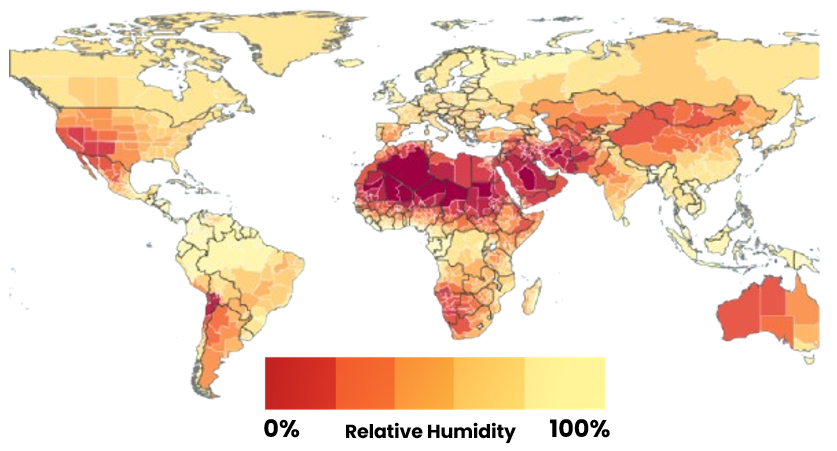
- 50% Relative Humidity – representing moderate conditions typically found in Central Europe
- 80% Relative Humidity – representing tropical, high-humidity climates such as Malaysia
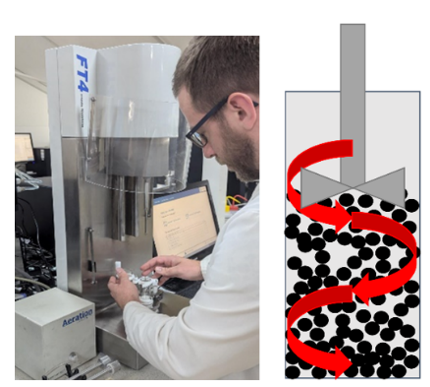
Flowability can then be quantified using dynamic powder flow measurements, a sensitive technique capable of detecting subtle changes in powder behaviour that simple methods often miss.
Business Impact
Our analytical testing approach at the Centre for Industrial Rheology offers a rapid, cost-effective way to predict flowability changes, bypassing the need for weeks of
conditioning or expensive pilot trials. This gives development and process teams a reliable basis for decision-making before processing problems, such as blockages or quality inconsistencies, ever arise. Specifically, we can inform:
- Whether flow aids are needed, and at what humidity threshold they become necessary
- The precise quantities of flow aids required to optimise usage and reduce costs
- Where process adjustments such as controlled drying or enhanced agitation are warranted
- Which markets or seasons represent the highest processing risk for a given powder
For multinational companies, this approach is especially valuable as it provides a way to validate processability across a global manufacturing network, ensuring that a product will run smoothly and consistently regardless of the country or specific facility in which it is produced.
We routinely carry out humidity assessments for powders, and our rapid turnaround times are designed to align with the pace of active development programmes and facilitate swift troubleshooting of any arising issues.
Contact us to arrange a discussion on powder measurements with our experts
Results
The results demonstrate the sensitivity of seasoning powders to ambient humidity. Testing revealed that high humidity (80% RH) severely impacts flowability, with even moderate humidity (50% RH) causing a measurable increase in total flow energy. Conversely, low-humidity environments (20% RH) showed a slight decrease in total flow energy, likely due to mild drying. Ultimately, these findings suggest that to maintain processing efficiency and prevent blockages, manufacturers must weigh the cost of implementing controlled drying environments against the use of flow aids.
The full analytical data supporting these findings are presented in the Analytical Findings section.
Extending The Study
Beyond the baseline assessment presented here, this framework can be adapted to address wider manufacturing challenges:
- Supply Chain & Packaging Evaluation: We can control both temperature and humidity to simulate your powder’s journey across transport, storage, and processing. By testing the powder both exposed and directly within its intended packaging, we can pinpoint exactly where environmental vulnerabilities arise before the product enters your facility.
- Clean-Label Reformulation: As consumers and regulators push back against artificial anti-caking agents like silicon dioxide, we can help you screen natural flow aids and determine the exact dosage required to maintain flowability.
- Comparative Benchmarking: We can evaluate a range of different powders at the same temperature and humidity to compare their relative hygroscopicity
Analytical Findings
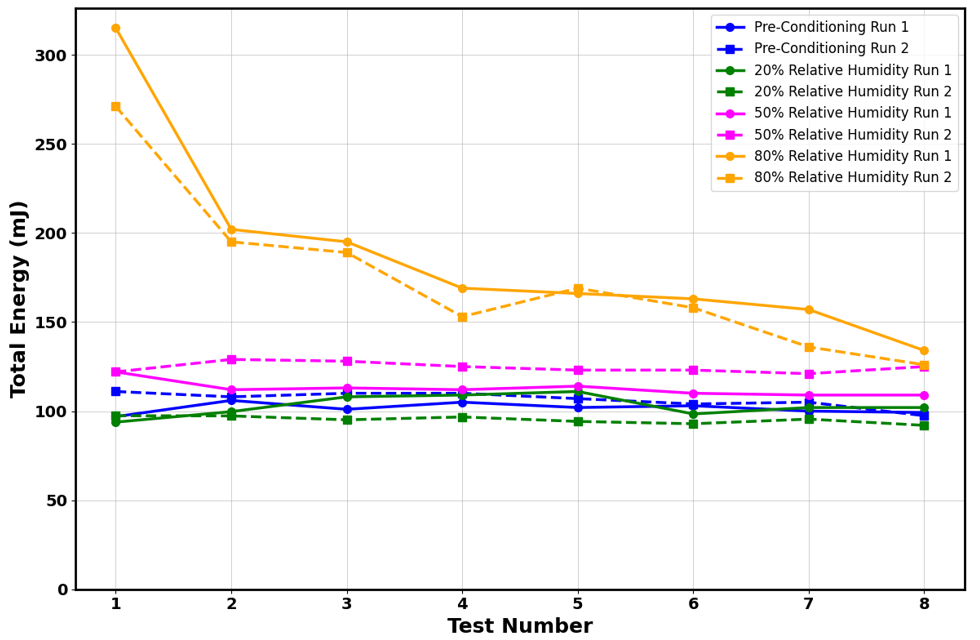
The results obtained show clear differences in flowability between powders that have been subjected to differing humidity conditions.
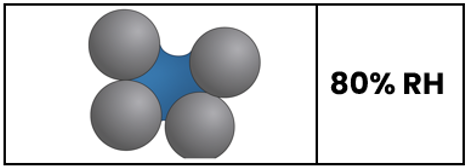 The 80% relative humidity sample showed the highest total energy values across the samples tested. This elevated humidity results in the formation of liquid capillary bridges, resulting in greater resistance to flow. This effect is clearly reflected in the elevated total energy values for this sample.
Interestingly, the first few runs highlight a pronounced increase in total energy, suggesting the presence of caking. Although further tests reduced the total energy, the values remained consistently higher than those of lower humidity. This reflects the strengthening effect of capillary bridges, which may have entered the funicular regime.
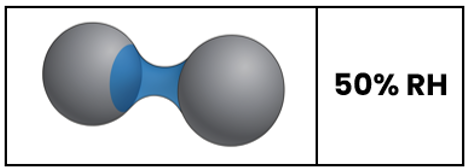 Even at a moderate relative humidity of 50%, measurable increases in total energy were observed. This indicates reduced powder flowability due to the formation of capillary bridges.
In contrast, the 20% relative humidity sample generally recorded the lowest total energy values out of the samples tested. This suggests improved flowability, with
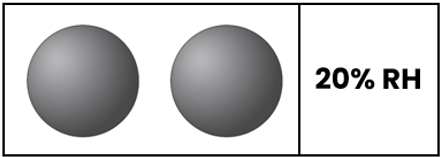
the energy reduction likely due to the removal of moisture, as lower relative humidity causes drying. This highlights that mild drying can enhance flowability in powders that may otherwise be moderately hygroscopic.
From a practical perspective, these findings emphasise the sensitivity of seasoning powders to even moderate humidity changes. In climates with higher ambient relative humidity, flow aids or enhanced agitation may be required to maintain process efficiency and prevent blockages. In addition to this, controlled drying to low humidity levels could be an effective way of improving flow without the use of chemical additives. The practical implementation of these solutions will depend on the cost and feasibility of maintaining such conditions during processing.
Theory – Mechanisms Behind Humidity Effects on Powder Flowability
Powder flowability can be significantly affected by relative humidity. The intrinsic ability of a powder to absorb moisture from the air is known as hygroscopicity. Not all powders are equally hygroscopic; some can remain relatively dry even at high relative humidity, while others begin to absorb water at much lower humidity levels. If a powder is highly hygroscopic, the absorbed moisture can condense at contact points between powders, forming thin liquid menisci. These menisci generate capillary forces, which act to pull the particles together, creating liquid capillary bridges.
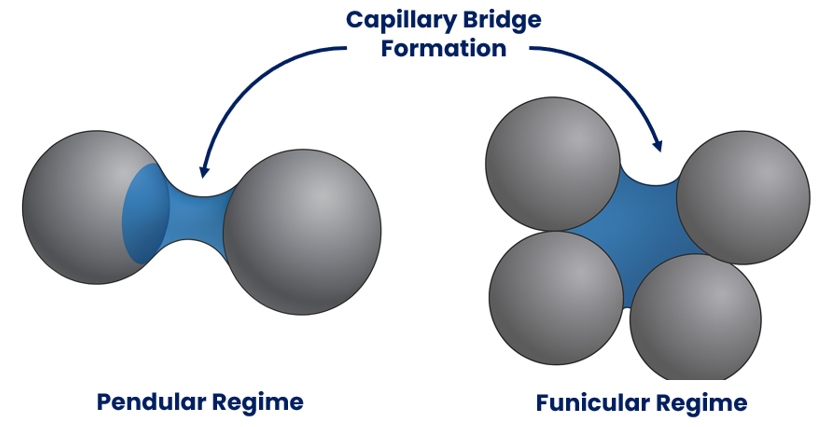
The presence of these capillary bridges increases particle adhesion, making powders more prone to agglomeration and reducing flowability. As humidity increases, these liquid bridges strengthen, and the system can enter the funicular regime. In this regime, individual capillary bridges begin to merge into larger clusters, forming a single liquid network that connects multiple particles.
Contact us so we can help solve your challenges with your powders

Related Articles;
Flow to Flavour: Dynamic Powder Analysis for Optimising Seasoning Coating
Same Humidity, Different Flow – Hygroscopicity of Seasoning Powders
Wasif Altaf serves as an Applications Specialist at the Centre for Industrial Rheology, leveraging a chemical engineering background (BEng) to bridge theory and practice. His work focuses on advanced rheological characterisation.